Universal Robots Gen 7 wants to facilitate the arrival of AI in factories
Universal Robots launches Gen 7, three cobots designed to more easily integrate vision, sensors and AI into factories. These are their limits and their prices.
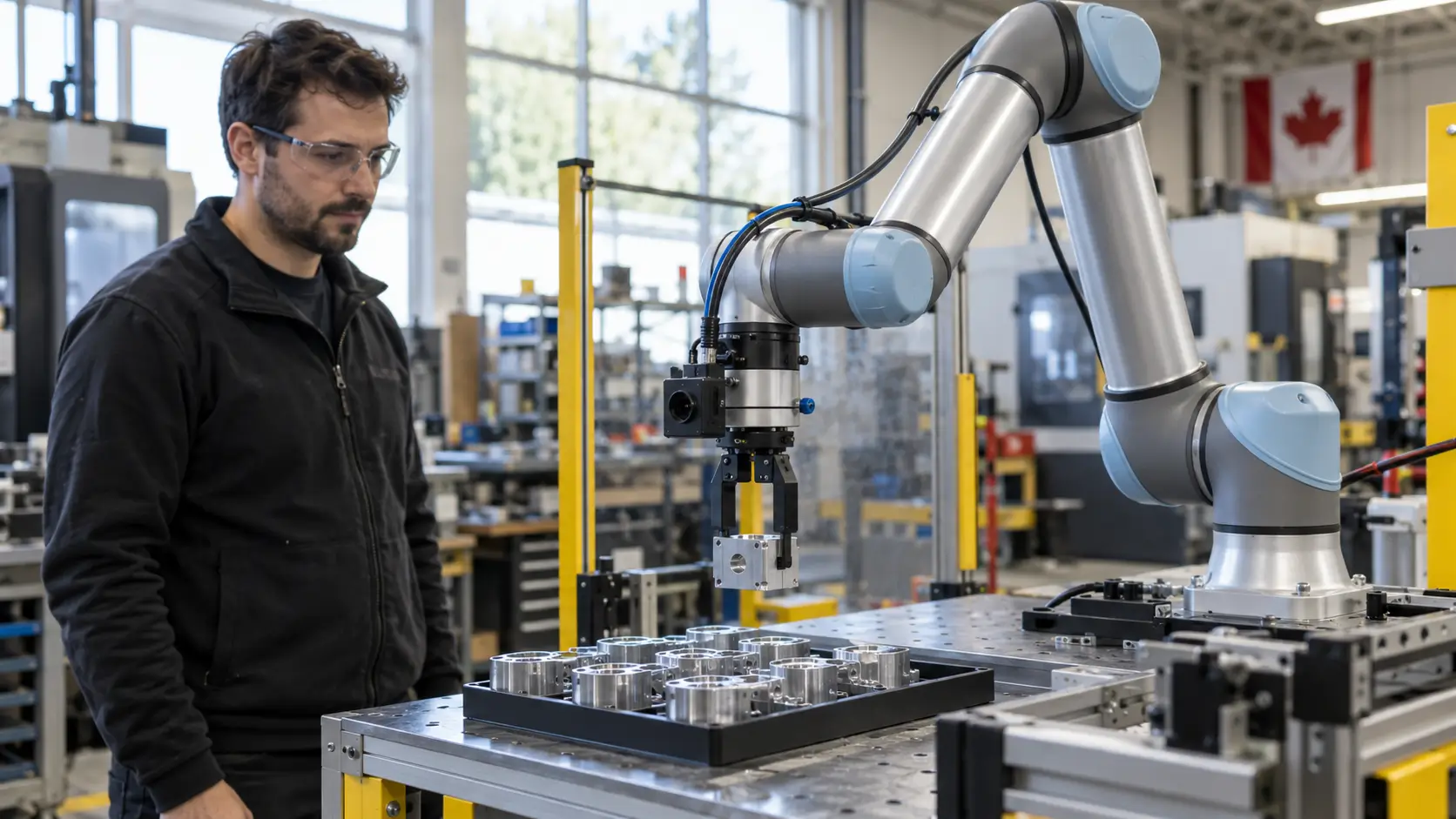
A collaborative robot can load a machine tool, inspect parts or perform a repetitive assembly near employees. The challenge, however, is not just to move your arm: you also need to integrate cameras, sensors, networks and security devices.
Universal Robots unveiled Gen 7 on September 14, 2026 at IMTS Chicago. The platform includes three new g-Series arms, a redesigned controller and a tool flange equipped to directly connect more sensors.
The manufacturer describes it as "ready for AI". This does not mean robots have general intelligence or learn alone in a factory.
Three arms for three compromises
The UR10g-1750 reaches 1,750 mm with a nominal load of 8 kg, increased to 10 kg under certain conditions. The UR17g-1300 reaches 1,300 mm with 15 kg in nominal speed or 17.5 kg in extended load. The UR18g-950 carries 18 kg by 950 mm.
The names of the first two reflect their extended load, not their nominal load. The official sheets of the g-Series indicate a maximum speed of 5 m/s for UR10g and UR17g, compared with 4 m/s for UR18g.
These maximums do not apply automatically when a person shares the workspace. The speed, strength and separation required depend on the application and its risk assessment.
A more direct connection to eyes and tools
The main novelty is at the end of the arm. The g-Series flange provides 1 Gbit/s Ethernet connection, 24 or 48 V power supply and security inputs. A camera, sensor or some tools can thus receive data and energy without as many external cables.
A force and torque sensor is also integrated. With impedance control, it can help the robot adjust its movement when inserting a piece or working against a surface.
A camera could locate a slightly displaced room, while a vision model would choose its socket position. A force sensor could then confirm that the assembly is correctly inserted.
The word "may" counts: performance will depend on the camera, model, data, tool and programming. Gen 7 provides infrastructure, but not a universal stand-alone solution.
A connected factory controller
The CB7 controller must communicate with programmable controllers, vision systems, industrial computers and production management software.
Universal Robots says it offers 40% more computing power in a 30% smaller housing than the previous generation. Automation World reports these comparisons, but no independent tests have yet been published.
The PolyScope X system supports open programming interfaces and ROS 2. Some of the AI treatments can work on the controller; Others will still require an external industrial computer.
The CB7 is also announced as compatible with the e-Series and UR Series arms. The precise list of functions accessible to these old models should be checked before upgrading.
Security: collaborative does not mean safe
The g-Series arms are certified by TÜV according to ISO 10218-1 and UL 1740. The safety architecture also reaches the PL d level, category 3, according to ISO 13849-1.
These certifications concern the robot and its control, not automatically the complete cell.
A clamp can crush a finger, a cutting piece can hurt and a projected load can become dangerous. An integrator must analyze the tool, materials, speeds, cornering points and human interactions. Some tasks will still require a fence, scanner or physical separation.
Prices and availability in Canada
Universal Robots displays all three models as new and allows you to request a demonstration or a prize. However, the company has not published any specific tariffs, shipping dates or Canadian dollar ranges.
Canadian distributors are already selling other robots of the brand, including [Electromate] (https://www.electromate.ca/). This does not confirm that g-Series are currently in stock or deliverable to Canada.
The final cost will vary depending on the arm, controller, clamp, vision, software, security, integration, training, support, distributor and region.
Limits or Considerations
No independent testing yet measures the long-term reliability, the time actually saved during integration or the quality of the applications of the AI presented at launch.
IP65 protects against dust and water jets, but does not make the robot suitable for all chemicals, sterile environments or food processes.
Finally, a simpler connection does not solve problems of lighting, insufficient data, distorted parts or unforeseen exceptions.
Conclusion
Gen 7 does not transform a cobot into an independent colleague. Its interest is more concrete: bringing power, data and safety signals to the tool, then offering more calculation and programming.
This base could facilitate visual inspection, parts handling and force-sensitive assemblies, particularly in small series.
It will now be necessary to check, in real plants, whether this integration effectively reduces time, cables and costs without complicating safety or maintenance.