Digit 5 wants to work near humans without industrial fence
Digit 5 wants to work near humans in factories. Here are its capabilities, its link to Toyota Canada, its theoretical price and current limits.
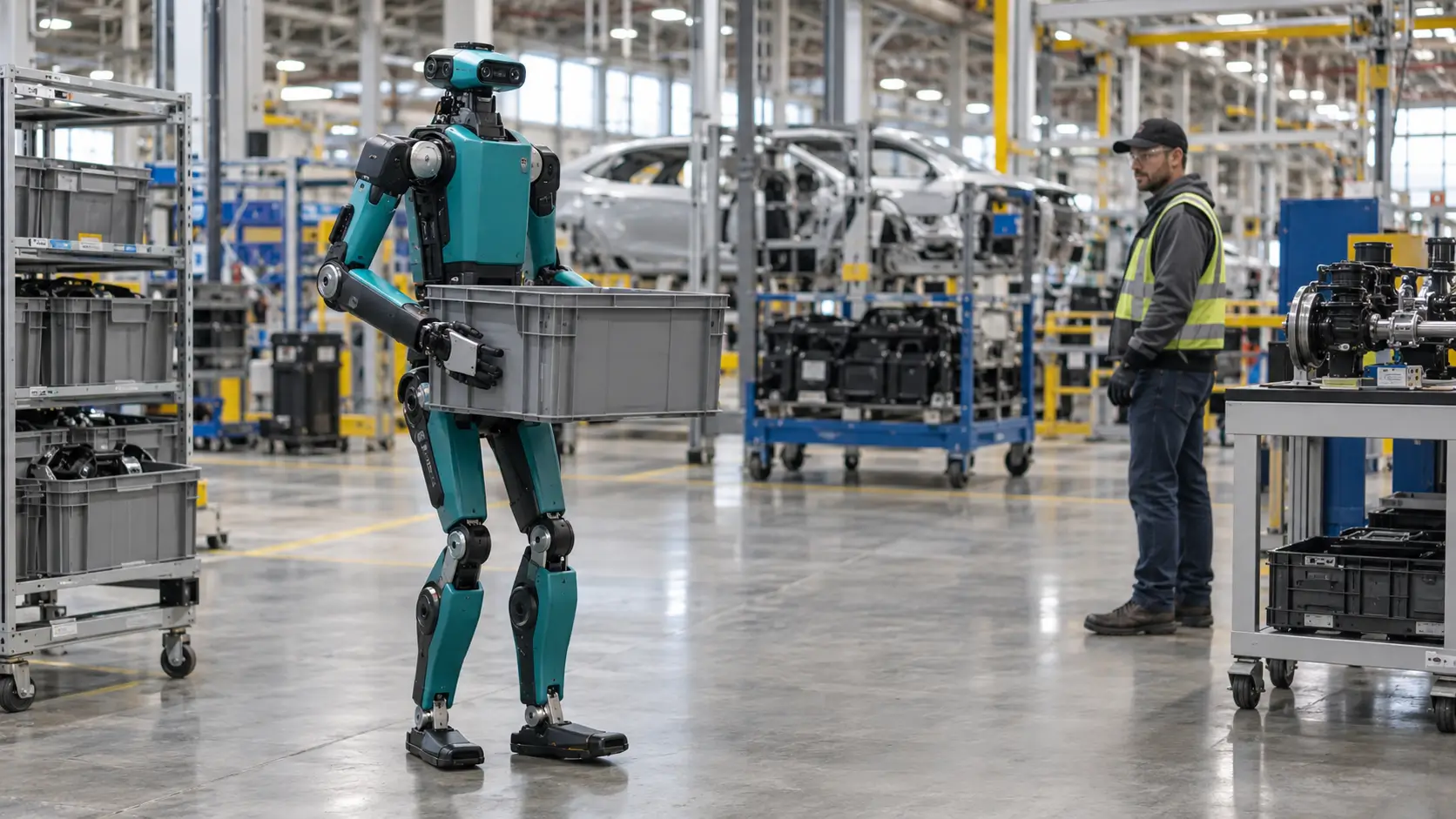
Traditional industrial robots are often locked behind barriers. A 129 kg machine capable of lifting a large load can seriously harm a person if it does not detect its presence.
Agility Robotics unveiled Digit 5 on September 15, 2026. This new humanoid for factories and warehouses must recognize workers who approach, slow down, stop or sit down to cut off the power of its engines.
This promise of working near humans is important. However, it remains to be validated on the commercial version, whose early access is only expected in 2027.
A handler, not a domestic robot
Digit 5 measures 1.81 m, weighs 129 kg and can reach a tablet at 2.2 m. His new leg architecture allows him to squat and repeatedly lift loads up to 22.7 kg, 40% higher than his predecessor, according to Agility.
His hands are actually interchangeable tools. A clamp can carry bins, while other actuators can be designed to power a machine, prepare sets of parts or handle pallets.
It is not a domestic robot: its tasks, tools, journeys and exceptional situations must be prepared and integrated into factory systems.
The official presentation by Digit 5 mentions a battery offering 90 minutes of work and a self-loading in nine minutes. The manufacturer deducts more than 20 hours of activity per 24-hour period. No independent test has yet confirmed this yield in production.
Seeing humans and reporting their movements
Digit 5 combines cameras, depth sensors and algorithms to monitor its environment. When a person enters an area deemed dangerous, the robot can avoid, slow or stop.
A separate security controller oversees these reactions. Light and sound signals must also tell workers what the robot is about to do.
However, it is not necessary to present Digit 5 as certified to work everywhere without fence. The ANSI/A3 documents and the ISO international standard for dynamically stable humanoids are still being prepared. Each facility will have to assess loads, tools, speeds, floors and people present.
Agility states that the previous generation has accumulated more than 65,000 hours of operation at Amazon, GXO, Schaeffler and Toyota. It would also have moved 100,000 bins to a GXO facility with approximately 98% accuracy. This data comes from the manufacturer and mainly concerns Digit 4, not yet Digit 5.
A direct link to a Canadian plant
Toyota Motor Manufacturing Canada signed a robot trade agreement as a service on February 19, following a pilot project at its Woodstock, Ontario plant.
The objective is to entrust Digit with certain repetitive and physically demanding logistics and production tasks, according to the joint announcement of Agility and Toyota Canada.
This agreement demonstrates that the previous technology has gone beyond mere demonstration. However, it does not confirm that Digit 5 is already in Woodstock or that the Canadian factory will receive the first copies.
Prices and availability in Canada
Agility plans to provide early access to Digit 5 in North America in the first half of 2027. The general availability for manufacturers, warehouses and distribution centres is foreseen before the end of 2027.
The manufacturer has not published any official prices or Canadian packages.
A financial document cited by [Business Insider] (https://www.businessinsider.com/agility-robotics-reveals-early-look-at-digit-5-humanoid-robot-2026-9) uses an illustrative scenario of US$200,000 for the robot, US$20,000 for deployment, and US$36,000 per year for software and maintenance. The theoretical total would reach approximately US$400,000 over five years.
It is not a commercial offer or a conversion into Canadian dollars. The real price will be negotiated and may vary depending on the number of robots, tools, integration, software, support, maintenance, contract and region.
Limits or Considerations
The capabilities presented at the launch are mainly based on the data from Agility. No independent body has yet published a full test of the series model.
Current Humanoid Tasks Digit remains relatively structured, including the movement of ferries. Recognizing a distorted object, recovering a fallen piece or reacting to an unforeseen situation remains much more difficult.
The announced orders of more than US$300 million also depend on certain contractual steps. They do not necessarily represent robots already delivered or revenues received.
Finally, human form is not always the fastest or least expensive solution. A conveyor, mobile robot or fixed arm may remain preferable when the process is stable.
Conclusion
Digit 5 seeks to solve an essential obstacle to the adoption of humanoids: allowing them to use spaces designed for humans without systematically isolating each machine.
Its increased strength, interchangeable tools and quick charging expand the tasks possible. Its Canadian relevance is real thanks to the partnership with Toyota in Ontario.
However, real progress will only be demonstrated once the commercial version has been independently evaluated and then allowed to work close to employees under daily production conditions.