TactiFlex Duo: two ways to treat an arrhythmia with a single catheter
Abbott combines two forms of cardiac ablation in a single catheter. The clinical study, U.S. approval and limitations show this.
To correct atrial fibrillation, a cardiologist can destroy very small areas of the heart that cause disorderly electrical signals. This intervention can use heat or, more recently, powerful electrical impulses.
Abbott announced on September 8, 2026 the American approval of TactiFlex Duo, a catheter capable of using these two forms of energy during the same operation.
This versatility could be useful in complex cases. However, it does not establish that the new device is superior to all existing specialized catheters.
Why do heart removal?
Atrial fibrillation is an arrhythmia during which the upper cavities of the heart beat rapidly and disorganizedly. It can cause palpitations, shortness of breath and fatigue, while increasing the risk of clot formation and stroke.
When medicines do not adequately control symptoms, removal may be considered. A catheter is then inserted into a blood vessel and guided to the heart.
The doctor creates tiny lesions around the pulmonary veins or in other targeted areas. The scar tissue then blocks some electrical signals that cause the arrhythmia.
Heat and impulses in the same instrument
Radiofrequency removal heats the heart tissue. This technique is well established and allows the doctor to treat precisely different anatomical forms, but heat can also reach neighbouring structures.
Pulse field ablation, or PFA, uses rather short high voltage pulses. They mainly produce a phenomenon called electroporation, which damages targeted heart cells without first depending on heat.
PFA can reduce some risk of thermal damage, but it is not safe. The choice of energy, intensity and location remains a medical decision.
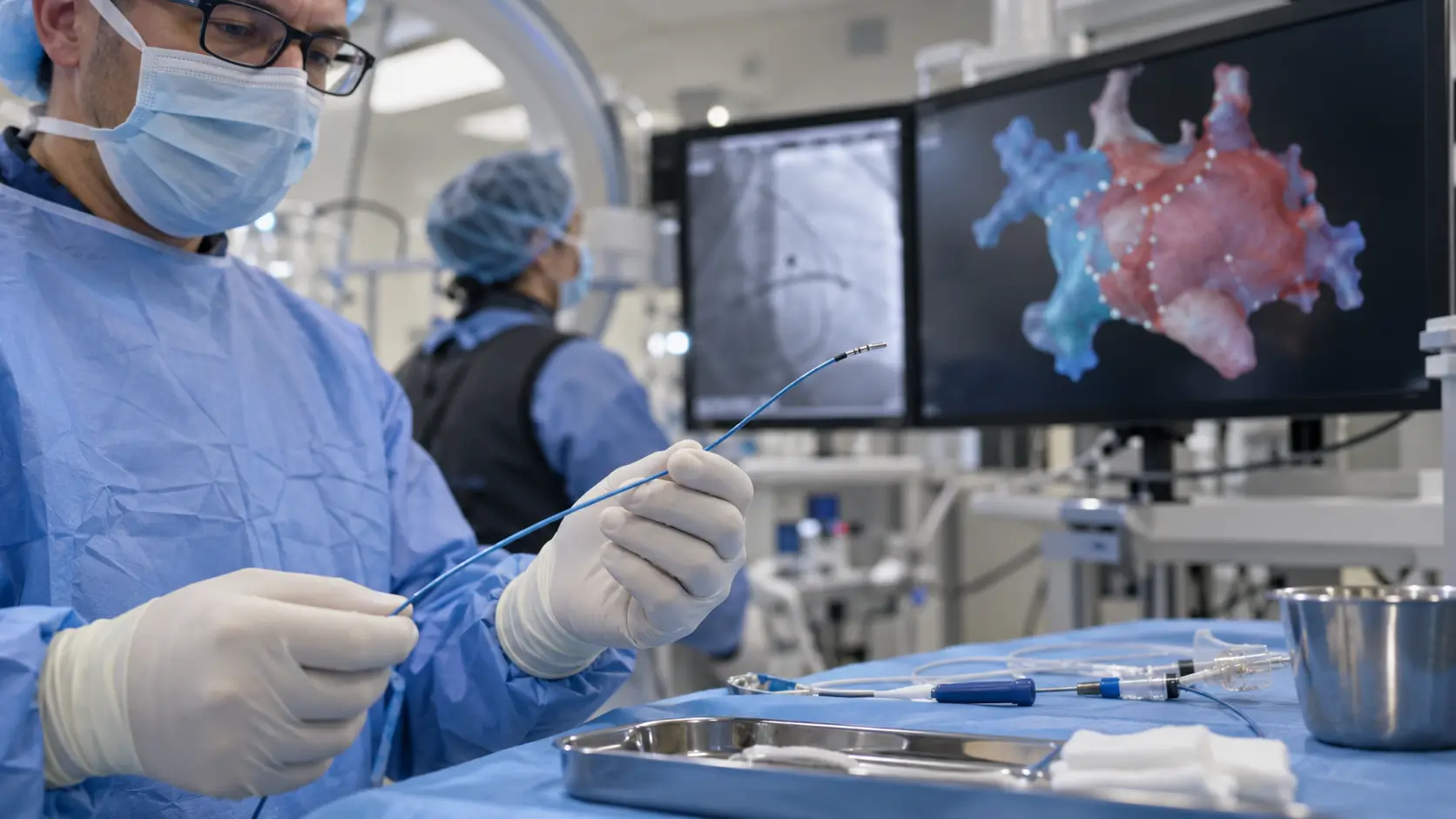
TactiFlex Duo allows you to switch from PFA to radio frequency without changing the catheter. Its flexible end also measures the force exerted on the heart wall.
The manufacturer states that its integration into the EnSite X mapping system provides a three-dimensional representation of the core and an index to help assess injury formation. This index remains an assistive tool: it does not directly prove that a lesion will be permanent.
What the clinical study shows
The FlexPulse study followed 180 people with symptomatic paroxysmic atrial fibrillation who did not respond adequately to medications.
Lung veins were isolated from 180 participants during the procedure. Additional regions were treated in 37.2% of them.
After 12 months, 74.6% of participants met the primary efficacy criterion. This required, among other things, the absence of documented arrhythmia, new surgery, cardioversion or significant modification of certain medicines.
The proportion without documented recurrence of fibrillation or other atrial arrhythmia was 77.4%. The rate of events corresponding to the main safety criterion was 1.7%, according to the results published in EP Europace (https://academic.oup.com/europace/advance-article/doi/10.1093/europace/euag238/8772350).
These figures are encouraging, but the study was neither randomised nor provided with a comparative group. It therefore does not conclude that TactiFlex Duo exceeds a catheter using only PFA or radio frequency.
Several authors also work for Abbott. Independent studies and data from a more diverse population will be needed.
Approval and availability
The U.S. Food and Drug Administration has approved TactiFlex Duo for certain atrial fibrillation procedures. Abbott plans to start cases in the United States before a wider deployment in the coming weeks, according to his official announcement.
The product also has a European CE marking since January. MedTech Dive notes that several manufacturers are now marketing competing pulsed-field ablation systems.
An earlier version called TactiFlex SE, limited to radio frequency, is already in use in Canada. It should not be confused with the new Duo model.
No Canadian registration of TactiFlex Duo, no launch date in Canada and no agreement with a Canadian hospital were found under the exact product name.
Prices and availability in Canada
Abbott did not report the price of the catheter, compatible generator or other necessary equipment.
It is a device for hospitals, not a product purchased directly by a patient. The cost of an intervention will depend on the catheter, mapping systems, medical fees, establishment, insurance, public scheme, configuration and region.
No reliable prices in Canadian dollars are available.
Limits or Considerations
Ablation remains an invasive intervention that can cause bleeding, vascular damage, accumulation of fluid around the heart, stroke or other complications.
The study dealt only with symptomatic and drug resistant atrial paroxystic fibrillation. Its results should not be automatically generalized to other arrhythmias or persistent forms of the disease.
The 12-month follow-up does not yet demonstrate sustainability over several years. In addition, the ability to choose between two energies can increase physician flexibility without necessarily simplifying each intervention.
Conclusion
TactiFlex Duo brings together two important techniques of modern electrophysiology in a single catheter.
FlexPulse results show that the apparatus can isolate lung veins with a relatively low level of safety events in the study population. However, the absence of a comparative group prevents it from being given clinical superiority.
Its real interest will emerge when hospitals use it on a large scale and independent studies directly compare its results, risks, duration of interventions and costs with those of existing systems.