Galaxy Brings Robotic Bronchoscopy into Commercial Practice in Asia
Galaxy brings robotic bronchoscopy into commercial practice in Asia. Here is its guidance, results, risks and availability.
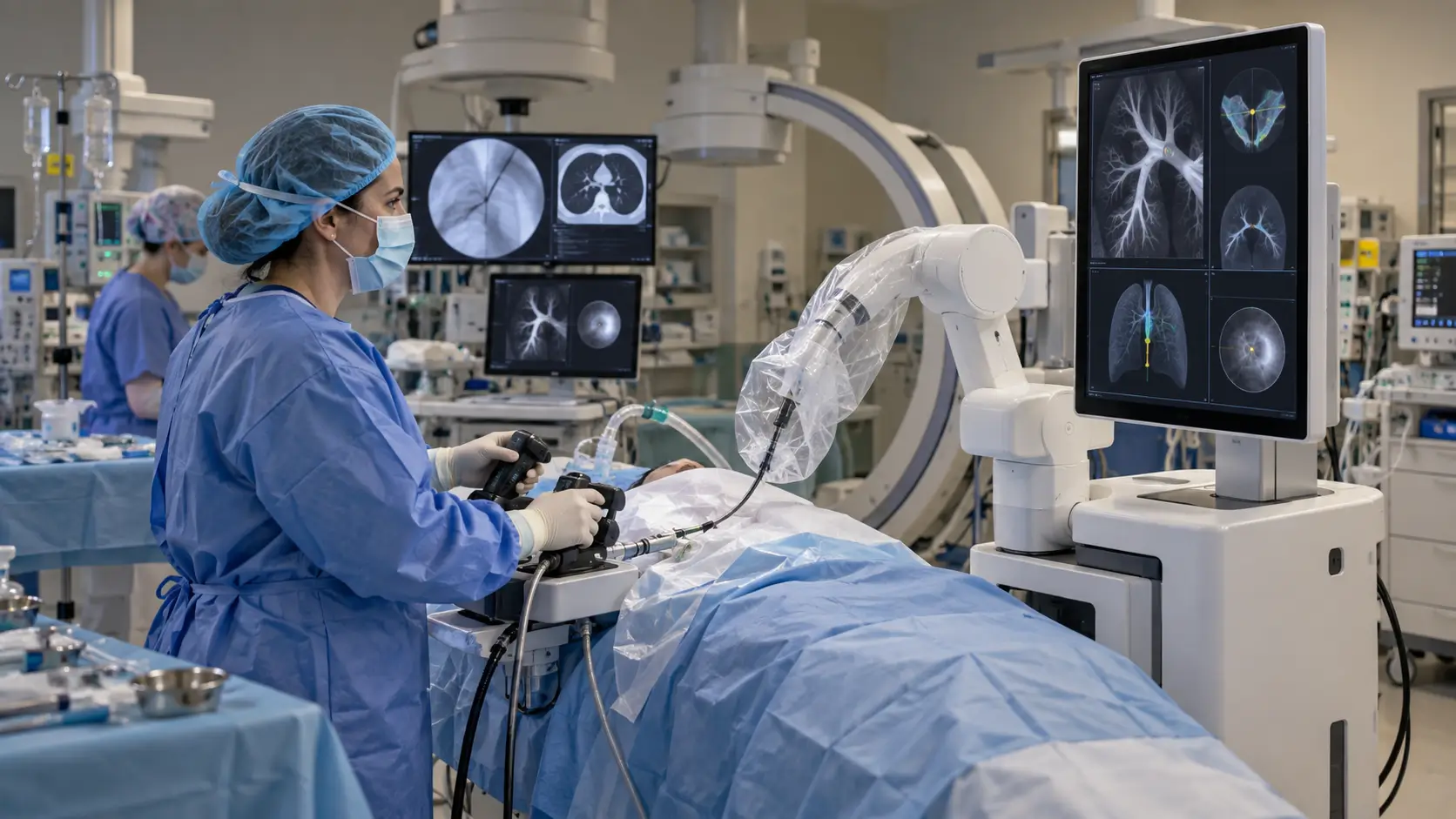
A small nodule located at the bottom of a lung can be difficult to reach without crossing the chest wall. Noah Medical's Galaxy system instead proposes to go through the mouth and natural branches of the bronchi, with a flexible bronchoscope guided by a robot and up-to-date images during the procedure.
On 29 September 2026, the Prince of Wales Hospital of Hong Kong conducted the first Asian commercial intervention with Galaxy. This is not the first regional trial of the system: the same establishment had been used in a clinical setting by December 2023.
A robot driven by the doctor
Galaxy does not biopsy independently. The doctor directs a flexible single-use bronchoscope and inserts the sampling instruments into his working channel.
Before surgery, a CT scan is used to construct a three-dimensional map of the respiratory tract. Electromagnetic sensors then indicate the position of the end of the bronchoscope relative to this map, according to the [FDA Regulatory Summary] (https://www.accessdata.fda.gov/cdrh docs/pdf22/K223144.pdf).
The challenge is that the patient's lung does not retain exactly the same form. Breathing, anesthesia and the position of the body can move the nodule relative to the previously taken image. This difference, called the divergence between the CT scannigram and the body, may make it appear that the tool is in the target as it passes.
X-rays to update the map
To correct this shift, Galaxy combines electromagnetic navigation with tomosynthesis. A radiological arc takes several images from different angles; the software assembles them to partially rebuild the area and update the target position.
A fluoroscopy overprint then helps the doctor align the biopsy tool. This imaging uses X-rays, so it does not suppress exposure of the patient and staff. The dose will depend on the number of scans, patient, equipment and team experience.
The platform holds on a trolley with a screen and an articulated arm. Its disposable bronchoscope avoids reprocessing between two patients, but also produces medical waste and a recurring cost. The manufacturer does not publish a complete comparative analysis of the environmental footprint.
Encouraging results, on a small group
In the prospective study FRONTIER, published in Respirology, Galaxy reached 19 nodules of 18 patients and the tool was observed in each target. Diagnostic performance was 89.5% strict and 94.7% intermediate. The injuries averaged 20 mm.
These results are promising, but the study was conducted in a single centre without a control group. Two patients had pneumothorax, one of whom required a drain at night, and one case of serious pneumonia was reported. The authors themselves demand greater multicentre prospective studies.
A [clinical review published in 2025] (https://pmc.ncbi.nlm.nih.gov/articles/PMC12260913/) estimates the combined diagnostic performance of robotic bronchoscopy, all systems, at about 84%. She states that no suitable direct comparison has yet established Galaxy's superiority on Ion or Monarch platforms.
Noah Medical claims that more than 16,000 interventions were performed in the United States. This total use comes from the manufacturer and is not an independent measure of accuracy or safety.
Commercial in Hong Kong, not confirmed in Canada
The announced commercial commissioning took place at Prince of Wales Hospital, a teaching hospital linked to the Chinese University of Hong Kong. It transforms previous clinical experience into routine use in this facility, without demonstrating widespread deployment in Asia.
In the United States, the FDA authorized Galaxy in March 2023 via channel 510(k), after finding that it was substantially equivalent to devices already marketed. The indication covers visualization and access to the respiratory tract for diagnostic and therapeutic interventions.
Noah Medical does not publish any purchase price, cost per intervention, or Canadian tariff. No registration, installation or date of availability in Canada was confirmed in the sources consulted. Costs will vary depending on the contract, disposable instruments, radiological arch, training, maintenance, hospital and region.
Limits or Considerations
Two American Class II recalls initiated in 2024 still appear as open in the FDA base. One concerns power supplies that can fail and interrupt an operation. The other adds precautions because some tools can catch when the bronchoscope is strongly curved; Forced insertion can cause tissue injury or pneumothorax.
These records do not prove that the device used in Hong Kong is affected. However, they must be checked before presenting the platform as fully tested.
The quality of a biopsy depends on the doctor, the size and position of the nodule, sampling and laboratory analysis. Reaching a target does not always guarantee sufficient tissue or accurate diagnosis.
Conclusion
Galaxy's first Asian commercial intervention shows that robotic bronchoscopy guided by imaging is now beyond the experimental stage in Hong Kong.
Its concrete interest is to bring the tool closer to a small nodule while remaining in the respiratory tract. The next evidence will need to come from broader multicentre data, direct comparisons and transparent monitoring of complications, recalls and costs.