Roman: Space telescope that sees a hundred times wider than Hubble
NASA's Roman space telescope is going to map the Universe, study dark energy and discover exoplanets. Here's his real abilities.
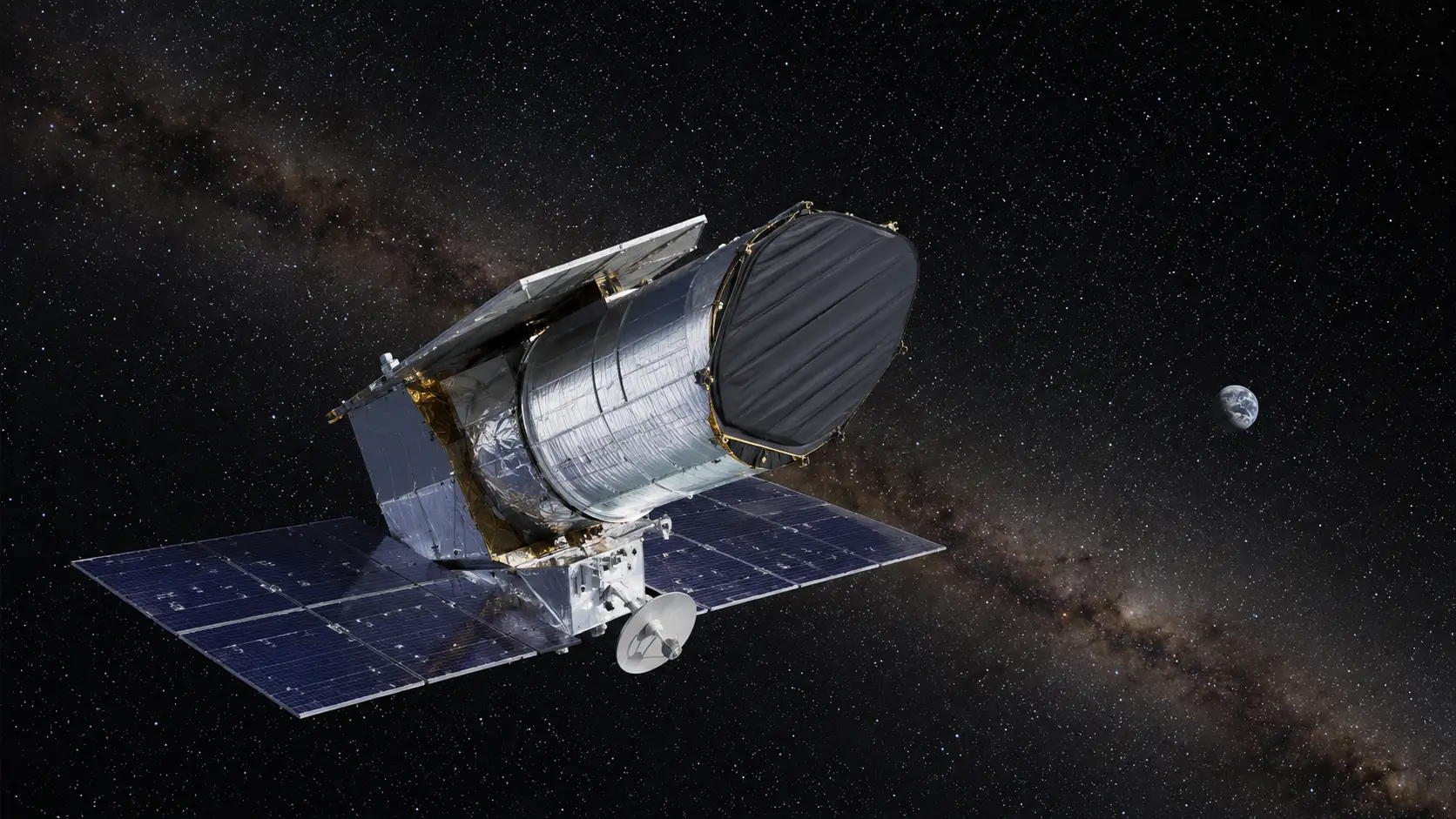
A new space telescope has just left Earth, but its first images are not expected immediately.
Launched on August 30, 2026, aboard a Falcon Heavy rocket, NASA's Nancy Grace Roman telescope now has to travel about 1.6 million kilometres before reaching the area where it will conduct its observations.
Roman will not only look to see further. Its main advantage will be to photograph much more sky at once in order to map the Universe, measure its expansion and discover exoplanets difficult to spot otherwise.
A panoramic camera of nearly 300 megapixels
Roman has a 2.4 metre primary mirror, the same diameter as Hubble. Its infrared resolution should therefore be comparable, but its field of vision will be at least 100 times larger.
Its main instrument, the Wide Field Instrument, consists of 18 4K detectors. NASA generally describes it as a camera of about 300 megapixels, while some data sheets specify 288 megapixels.
Only one image will cover a region of the sky larger than the apparent full moon. Over five years of observation, Roman should photograph more than 50 times the area covered by Hubble during its first 30 years.
NASA states that the observatory will be able to survey the sky up to 1,000 times faster than Hubble while maintaining similar infrared sensitivity and resolution. This comparison covers large panoramic surveys, not all possible observations.
Mapping the invisible universe
Dark energy is the name given to the phenomenon associated with accelerating the expansion of the Universe. Dark matter, for its part, does not produce detectable light, but its gravity influences galaxies and distorts images of more distant objects.
Roman will observe more than a billion galaxies. By measuring their distribution, some supernovas and the deformations produced by gravitational lenses, scientists can test different models explaining the evolution of the Universe.
The telescope will produce up to 1.4 terabytes of data per day, according to the [NASA] (https://www.nasa.gov/news-release/nasas-dark-universe-seeking-nancy-grace-roman-space-telescope-launches/). Machine learning tools and citizen science projects must help sort out this amount of information.
Several methods for finding exoplanets
Roman will monitor the dense centre of the Milky Way to detect gravitational microlentils.
This happens when a star or planet passes almost exactly before a more distant object. Its gravity temporarily amplifies the light coming from the background.
This method can reveal cold planets, distant from their stars or even wandering without a known star. NASA plans to discover more than a thousand exoplanets per microlentil and detect many other passages of planets in front of their stars.
Roman also carries an experimental coronographer. This instrument masks the light of a star in order to try to photograph directly the giant planets around it.
The coronographer remains a technological demonstration. In particular, it must prepare instruments for future missions, but Roman is not designed primarily to look for traces of life. The Associated Press points out that it will instead be used to identify and characterize worlds that other telescopes can then study in depth.
A mirror from recognition material
Roman's mirror comes from a set transferred to NASA by the American National Recognition Office.
However, it would be misleading to describe the entire observatory as a merely recycled spy satellite. NASA has changed the shape and surface of the mirror, then developed new instruments, a new structure and a space vehicle corresponding to its scientific objectives.
The mirror weighs about 186 kg, much less than Hubble's despite its identical diameter. Its surface also received an optimized silver coating for near infrared light, as explained in the [NASA technical documentation] (https://www.nasa.gov/missions/roman-space-telescope/primary-mirror-for-nasas-roman-space-telescope-completed/).
Cost, Calendar and Access to Canada
Roman is heading for an orbit around the second point of Lagrange Soleil-Terre, or L2. Travel and commissioning must last about three months. NASA plans to publish the first images in early 2027.
The main scientific mission must last five years. The observatory has enough fuel to support an additional five-year extension, but this will depend on its status and budgetary decisions.
Journalistic estimates of cost vary: Reuters advances about US$4 billion**, while Associated Press and The Guardian speak of 4.3 billion. No approximate conversion to Canadian dollars is proposed here.
Roman is obviously not a commercial product and has no price or sales schedule in Canada. However, its data will be public without any period of exclusivity. NASA states that astronomers around the world will be able to consult them and propose research.
Limits or Considerations
A successful launch does not yet guarantee the complete operation of the observatory. The deployment of the antenna, the opening of the lid, the path to L2 and the calibration of the instruments are still critical steps.
The coronographer is a technological experience and may not achieve all expected performance. Estimates of the number of planets or galaxies observed are also based on NASA models and survey plans.
Roman will mainly produce infrared images and scientific datasets. He will not replace Hubble or the James Webb telescope: his panoramic vision must instead identify phenomena that other observatories can examine in more detail.
Conclusion
Roman brings an unusual combination to space astronomy: a mirror the size of Hubble's and a camera capable of covering a much larger portion of the sky.
This panoramic vision could transform the study of cosmic expansion, dark matter and exoplanet populations.
The observatory is now in space, but its real mission is just beginning. The next few months will determine whether its deployment, calibration and first readings are delivering on the multi-billion dollar project's promises.