Microduck: a small robot that you can drive yourself
Microduck is a biped robot with open source code that is trained in simulation. Here are its capabilities, its price, its autonomy and its real limits.
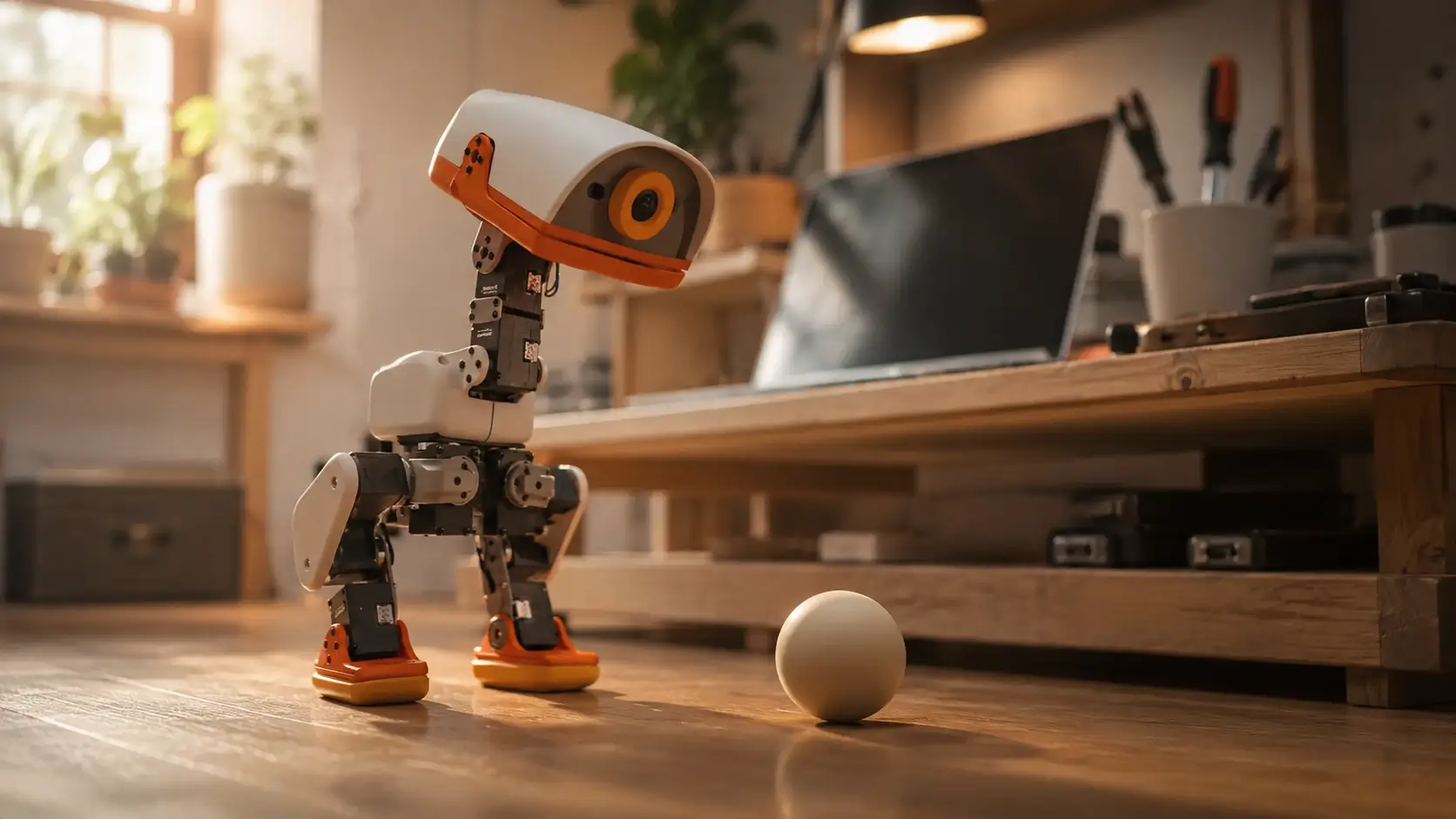
It measures only 25 cm, has a camera eye, an articulated beak and two legs controlled by about fifteen engines.
Microduck looks more like an animated character than an industrial robot. Behind this voluntarily friendly appearance is, however, a true open source robotic learning platform.
Presented on August 27, 2026 by Pollen Robotics and Hugging Face, this robot can walk, grab small objects, get up after a fall and learn new behaviors developed in a simulator.
He is not a domestic assistant and his announced abilities have not yet been independently verified.
A relatively accessible biped robot
Microduck measures 25 cm and weighs less than 900 g. Its body has 15 motors, including legs, neck and beak.
A camera installed in his single eye allows him to observe his environment. It also has a small LiDAR sensor to measure distances and two inertial power stations that detect its movements and orientation.
Pollen Robotics claims that the robot can grab an object weighing up to 800 g with its beak. The official demonstrations show it picking up a sock or marker, pushing a balloon and rising after being overturned.
These demonstrations were produced by the manufacturer. They do not yet make it possible to judge its reliability on different surfaces or the success rate of each movement.
The Official Microduck Presentation indicates that seven trained behaviours are provided. In particular, the robot can walk, sit, stand up, kick, grab an object and move on small optional wheels.
Learning in a virtual world before moving
The main feature of Microduck is its learning environment by strengthening.
In this method, a virtual agent continually tries different actions. Movements that bring him closer to his goal are rewarded, while falls and mistakes are penalized.
The training is done first in MuJoCo, a physical simulator capable of approximately replicating gravity, joints, collisions and friction. Once the behaviour is sufficiently stable, the policy obtained can be transferred to the actual robot.
This approach allows thousands of tests to be carried out without using the engines or constantly dropping the aircraft.
However, the transition from simulation to real world is never perfect. A slippery surface, a lower battery, a slightly different engine or a poorly positioned object can produce an absent result of the simulation.
Pollen Robotics therefore foresees a cycle where the developer drives behavior, deploys it, observes errors, adjusts simulation and repeats.
Open software but limited hardware
The manufacturer publishes the SDK, simulator and learning policies under Apache 2.0 license. Users can study the code, modify it and share their own behaviours.
This openness is important for students, laboratories and enthusiasts who want to understand the operation of a robot rather than just using a closed application.
However, on-board equipment remains modest. [The Verge reports] (https://www.theverge.com/gadgets/985549/hugging-face-microduck-robot) that Microduck uses a Rockchip RK3566 processor. According to [Engadget] (https://www.engadget.com/2245407/huggingface-and-pollen-robotics-opn-pre-orders-for-the-microduck-robot/), it has 1 GB of RAM and 32 GB of storage.
The robot executes its movement policy at a announced frequency of 50 Hz, a decision every 20 milliseconds. However, demanding workouts must be done on another computer or via the Hugging Face Jobs service.
Wi-Fi and Bluetooth connections allow you to transfer programs and use the included controller. A microphone and speaker are used to produce small sounds, but Microduck is not presented as a conversational vocal assistant.
Prices and availability in Canada
Microduck is offered in a single main configuration at US$ 399, before taxes and shipping charges. The box includes the robot, a battery, a USB-C cable and a controller.
Official accessories cost between US$ 39 and US$119:
- charging system with two batteries: US$39;
- set of accessories with castors, balloon and NFC markers: US$39;
- development set with motors, cables, batteries and tools: US$119.
These prices are in US dollars. No reliable Canadian pricing is published and no approximate conversion is proposed here.
The final price may vary depending on accessories, taxes, delivery, import duties, promotion and region.
Pollen Robotics plans to start shipping before Christmas 2026. Engadget states that the first deliveries are for the United States. No date or guarantee of delivery specific to Canada has been confirmed.
Limits or Considerations
The manufacturer announces about an hour of autonomy with the 2,600 mAh battery. This estimate has not yet been verified under actual conditions and may vary depending on the movements, sensors and state of the battery.
Microduck has no arms and can only perform small manipulations with his beak. Its size makes it interesting on a desk or in a classroom, but not useful for household tasks.
The printed engines, joints and parts can also be used or broken during experiments. Finally, the presence of a camera and microphone requires checking how images and sounds are processed, recorded and transmitted.
The software is open, but it will be necessary to confirm which mechanical parts and electronic diagrams will be published. "Open source code" does not necessarily mean that all material can be freely reproduced.
Conclusion
Microduck does not promise to store the house or become a universal smart companion.
Its objective is more realistic: to make robotic learning sufficiently accessible so that a student or enthusiast can train simulation behavior, transfer it to a real machine and observe what works.
At US$399, the price remains high for a toy, but relatively low for a programmable biped robot with 15 engines, a camera and a LiDAR.
Its true value will now depend on the quality of its software, its mechanical resistance, the real autonomy and the manufacturer's ability to deliver the first units as expected.