Nova passes 30 W through a window to install 5G without piercing
Canadian Nova technology transmits up to 30 W through a window to power an external 5G modem without drilling or crossing cable.
Nova passes 30 W through a window to install 5G without piercing
Installing a 5G modem on the outside often improves reception, but normally requires you to drill the wall or pass a cable through a window. Solace Power, a company from Mount Pearl, Newfoundland and Labrador, has just launched the large-scale production of Nova, a module capable of transmitting up to 30 W of electricity through glass.
The product does not seek to charge a phone remotely. It focuses on manufacturers of 5G fixed access terminals, which will be able to put the cell receiver out while keeping its power source inside.
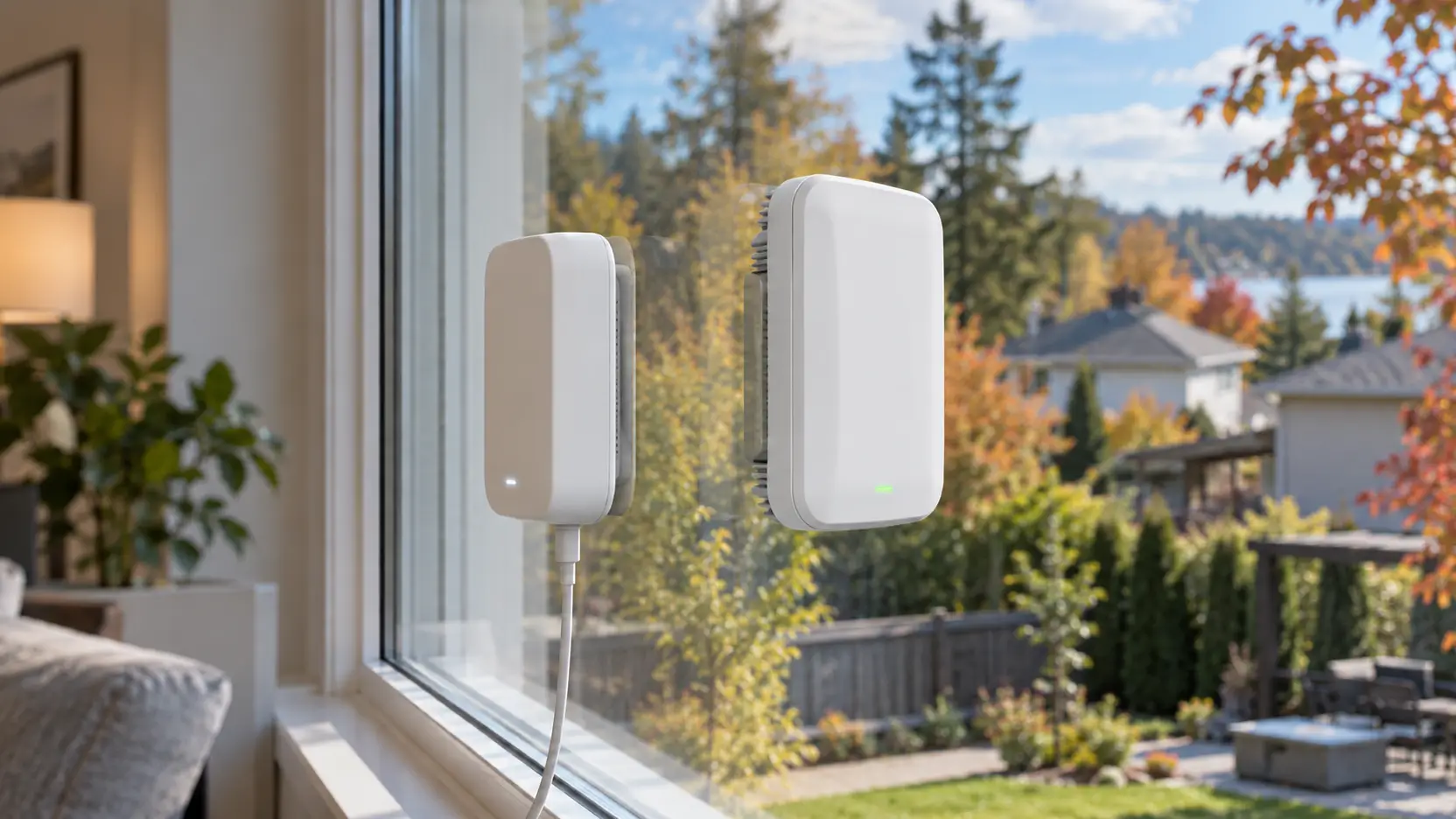
Two modules separated from the window
The principle is based on two elements aligned on both sides of the glass pane. The indoor module, plugged into the house, creates a field allowing the outdoor module to receive energy without physical connection through the glass. A technical documentation published by Solace Power describes an inductive transfer using an in-house transmitter coil and an external receiver coil.
On October 6, 2026, the company announced that [Nova had entered large-scale production] (https://solace.ca/news/solaces-nova-module-enters-high-volume-production-and-opens-for-customer-orders). Manufacturers can now order the module and the first deliveries are scheduled for the fourth quarter of 2026.
Solace announces a maximum power of 30 W. This is enough for several external 5G modems, but not for all imaginable network equipment. The actual power available will depend in particular on the thickness of the window, its coatings, the alignment of the modules and the integration carried out by the terminal manufacturer.
Why put the modem out
Wireless fixed access, or FWA, uses a cellular network to provide Internet to a residence or business. The modem must therefore capture the signal of a 4G or 5G antenna and then transmit it to the local network.
Modern walls and windows can greatly mitigate this signal. Low-emission glazing, called Low-E, often contains thin metal layers that improve thermal insulation, but also reduce the passage of radio waves. A professor of radiofrequency engineering interviewed by [Mobile World Live] (https://www.mobileworldlive.com/5g/feature-how-radio-signals-can-penetrate-the-heart-of-glass) confirms that the problem becomes more important when frequencies increase.
Placing the receiver outside avoids part of this loss. So far, this solution generally required a technician, an outside cable and a hole in the building envelope. With Nova, the user could instead attach both elements to the window and plug only the inner part.
Nova alone, however, is not a complete Internet service. The terminal manufacturer must still provide the 5G modem, the weather resistant housing and a means to transport the data inwards. Some partner solutions use a LiFi optical link; other architectures could use a different link.
A Canadian technology for manufacturers
Solace says its system works with single, double or triple windows and tolerates up to 30% misalignment without loss of performance. The company is also promoting compatibility with about 98% of global residential windows. These figures come from the manufacturer and the full details of the tests are not public.
However, the transition to production is an important step. In January, RCR Wireless News still described the terminal developed with NetComm as a product under evaluation, without a definitive commercial calendar. Nova is now commandable as a component and not just presented as a demonstration.
The company states that the module is certified by the United States Federal Communications Commission. However, it did not publish the specific certification number in its advertisement or confirm an equivalent Canadian registration.
Limits or Considerations
Nova is not a gadget that the consumer can buy today in a store. It is a component sold to equipment manufacturers and operators. No residential terminal incorporating the production version, no Canadian supplier and no retail prices have yet been announced.
Solace also did not communicate the price of the module. The final cost will depend on modem, data system, enclosure, operator package, installation and region.
The exact energy efficiency is not published. Part of the electricity is necessarily lost during a wireless transfer; It is therefore necessary to compare the full consumption with that of a wired power supply. There is also a need to document the effect of frost, condensation, winter temperatures, sun, vibrations and aging of adhesives.
Not all windows will necessarily be suitable. High-frequency metal coatings, particular frames and certain thicknesses can influence the transfer. An installation on an open window could also complicate its normal use or cleaning.
Conclusion
Nova is tackling a problem that is not very visible, but very concrete: getting an external modem received without turning its installation into construction. The ability to pass up to 30 W through a window could facilitate the deployment of the 5G fixed Internet in hard-to-serve homes.
Technology comes from Canada and is now in production, but it remains an element of a future product rather than a ready-to-buy device. Its success will depend on the manufacturers who will integrate it, the operators who will adopt it and the results achieved in real houses, especially in the Canadian climate.