Uber and Wayve launch taxis in London driven by an AI
Uber and Wayve run autonomous supervised taxis in London. This is how the AI drives, why a human stays on board and the limits of service.
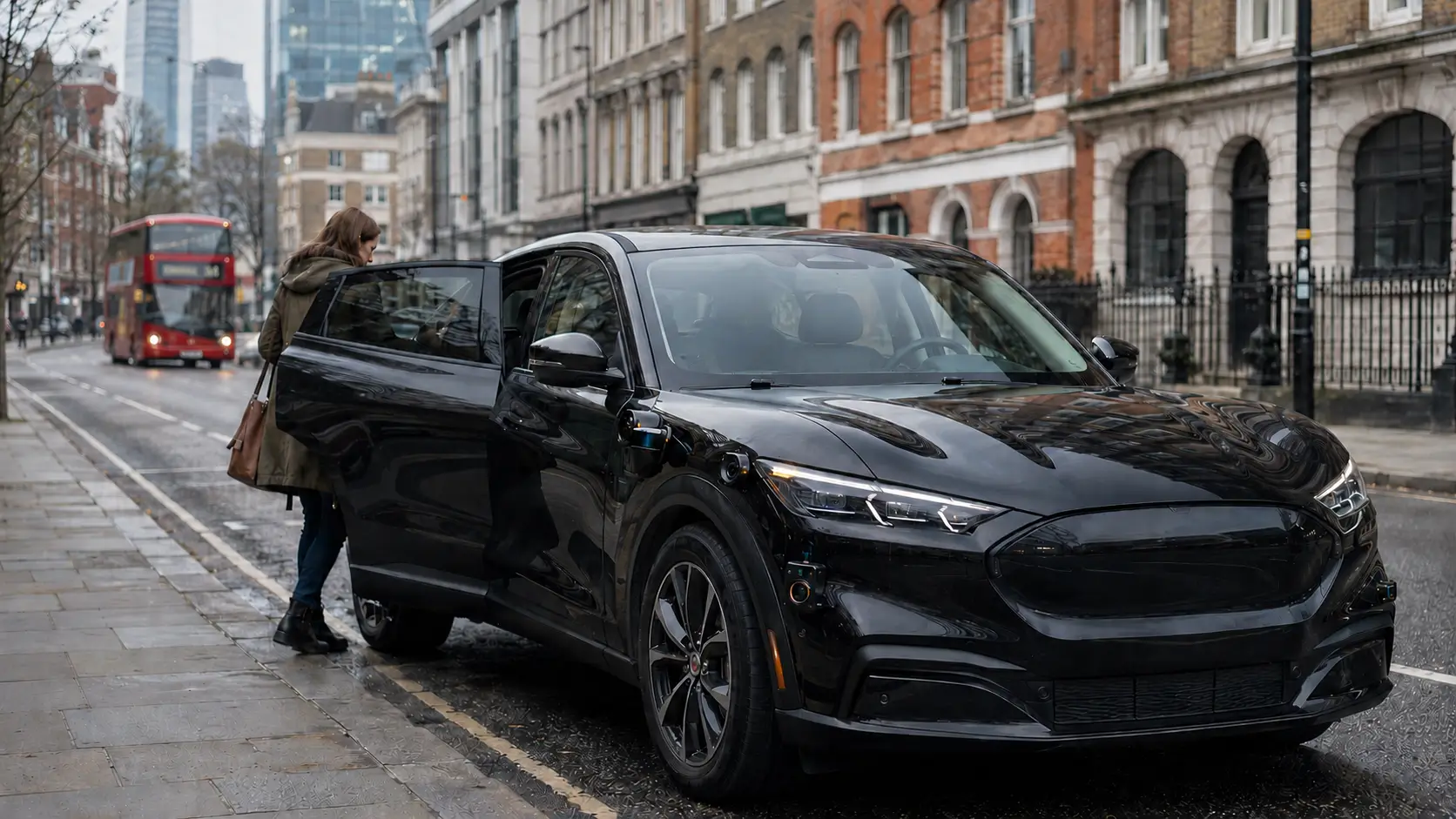
A London customer who orders an ordinary race on Uber can now see a car coming whose steering wheel, accelerator and brakes are mainly controlled by artificial intelligence.
Launched on September 3, 2026, the service uses electric Ford Mustang Mach-E modified by Wayve. It is an important step for self-driving in Europe, but the term " taxi without a driver" would be premature: a safety driver remains at the wheel of each vehicle.
How to get an autonomous race
Customers normally order a UberX, Uber Electric or Uber Comfort route. If a Wayve vehicle is available, the app can offer them this option without any special supplement.
The passenger can accept the autonomous vehicle or request a conventional car before arrival. It can also increase its chances of being selected by activating its preference for autonomous vehicles in the application parameters.
The official release from Uber indicates that travel can occur in Greater London except to airports.
Only 15 vehicles were reported to have obtained a launch licence, according to The Guardian. Thus, the chances of receiving one of the approximately 100,000 private transport vehicles in the capital remain low.
An AI that drives without a high definition card
Wayve calls his AV2.0 approach. Rather than programming each road situation and constantly depending on a detailed three-dimensional map, the company will lead a model to interpret the images and data captured during driving.
Mustang Mach-E use cameras and radars installed around the body. They do not use the LiDAR, this laser sensor used by several competitors to measure precisely the shape and distance of objects.
Wayve states that its model can adapt to new roads, weather conditions and vehicle configurations. This adaptability remains an assertion by the manufacturer: no public report yet provides the response rates, distances travelled between two problems or detailed results by weather type.
The lack of high definition maps and LiDAR could reduce complexity and facilitate deployment to new cities. However, it increases the importance of camera quality, radar, training data and model decisions.
Why a driver stays behind the wheel
Each race includes a professional driver trained and authorized by Transport for London. He monitors the road and must be able to resume control immediately.
The [British Automated Vehicle Test Code] (https://www.gov.uk/government/publications/trialling-automated-vehicle-technologies-in-public/code-of-practice-automated-vehicle-trialing) requires that this supervisor has a complete view of the road, remains attentive and can neutralize the system.
The car is therefore not yet allowed to carry its passengers alone. A separate regulatory procedure will have to evaluate the vehicle, its software, operation of the service and safety measures before removing the driver.
Reuters reports that regulatory barriers still prevent Uber and Wayve from setting a date for fully autonomous travel.
A particularly difficult traffic
London has narrow streets, irregular intersections, buses, cyclists and pedestrians that can cross other than designated crossings.
This variety makes it a more demanding test than a limited route to a few large arteries. However, it does not prove that the system can work everywhere: successful human intervention can prevent an incident without publicly revealing that the AI had failed.
The European Union's role in this area is to promote the development of the European Union's economic and social cohesion.
Wayve will eventually replace the vehicles processed with Nissan Leafs incorporating its equipment from the moment they are manufactured. Their business schedule and safety results have not yet been confirmed.
Prices and availability in Canada
Uber does not impose any surcharge specific to Wayve vehicle. The customer sees the estimated rate in the application before accepting, as for a conventional race.
There is therefore no fixed price or universal range. The cost varies according to distance, duration, Uber category, demand, promotions and region.
The service is limited to Greater London and excludes airports. No launch of Wayve technology on Uber in Canada has been announced.
A person in Quebec or elsewhere in Canada cannot order this robotaxi. A possible arrival would require suitable vehicles, local operation and authorization from the relevant Canadian and provincial authorities.
Limits or Considerations
The fleet is too small and deployment too recent to provide a representative safety assessment.
Uber and Wayve did not publish the number of autonomous kilometres, the frequency of retakes, the incidents avoided or the performance in rain, fog or darkness.
A model trained with many situations can still misinterpret a gesture, a temporary construction site, an unusual object or the unpredictable behaviour of another user.
The launch also raises economic issues. Uber claims to want to maintain a mixed network of human drivers and autonomous vehicles, but the eventual disappearance of the driver would necessarily change jobs and income sharing.
Finally, a service offered to the public does not amount to full authorization. As long as a driver is required to monitor the AI and assume emergency recovery, the technology remains in the learning and validation phase.
Conclusion
Uber and Wayve move their demonstration system to daily use with real London passengers.
The approach without LiDAR or high definition cards could facilitate its adaptation to several cities and car models. London will now be able to verify this promise in a dense and unpredictable traffic.
However, the true technological threshold will only be reached when companies publish solid safety results and obtain permission to withdraw the driver. For the moment, AI drives, but a human remains his indispensable safety net.