Paraborg: Cyborg cockroaches to carry drugs under the rubble
Cyborg cockroaches with cameras and micro-injectors could help under the rubble. This is their operation, their potential and their limitations.
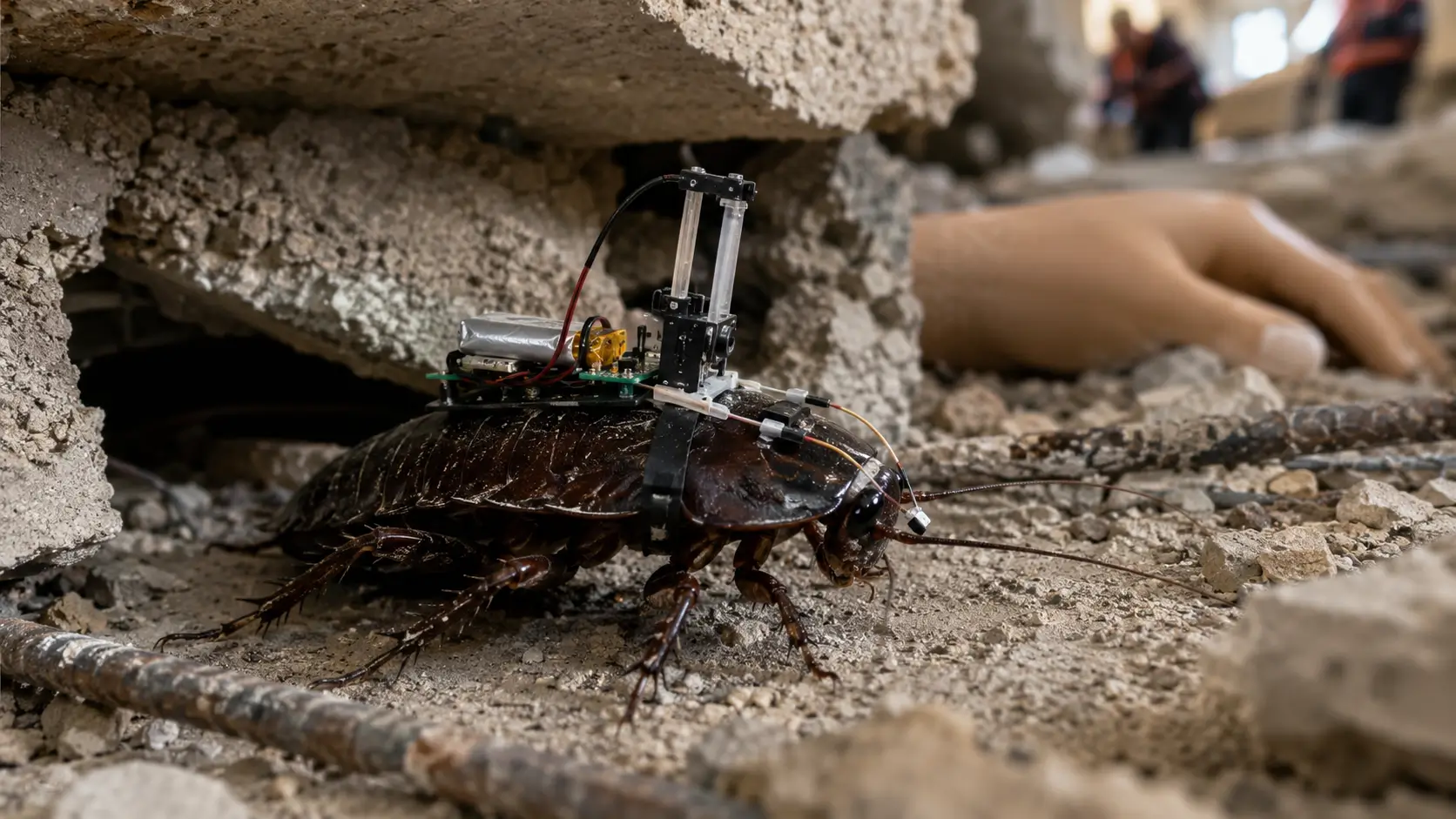
After the collapse of a building, rescuers may have to wait before entering an unstable cavity. Small robots can explore some passages, but their wheels, battery and joints limit their mobility in debris.
Australian researchers propose an unusual solution: using the body of a real cockroach as a robotic platform.
Presented on 27 August 2026, Paraborg combines a remote-controlled insect, a camera and a micro-injector. It could eventually reach a victim before the first responders, but the technology remains a prototype laboratory that has never administered a drug to a human.
An animal transformed into a robotic platform
Researchers at the University of Queensland and the University of New South Wales use the giant roache of Queensland, or "Macropaneshia rhinoceros".
This species can measure about 8.5 cm and carry more equipment than small domestic cockroaches. A removable structure mounted on its back contains a battery, communication circuits and, depending on its mission, a camera or injection mechanism.
Electrodes stimulate antennas and cerques, sensory organs located at the back of the insect. The operator can thus cause a turn or encourage movement without replacing muscles and legs with engines.
According to the [Official Presentation of Queensland University] (https://news.uq.edu.au/2026-08-paramedic-cockroaches-cyborg-care-when-reescuers-cant-reach), insects are anesthetized during the installation of electrodes and return to normal life after the harness has been removed. This last statement is from the research team and will need to be documented on a larger number of animals.
Two cockroaches with complementary roles
The scenario studied uses at least two Paraborgs. The first one carries a Wi-Fi camera and provides images to rescuers. The second follows with the injection device.
Once the target is identified, an operator positions the insect carrying the micro-injector. The final trigger remains under human control, an essential precaution when a medical decision could lead to serious consequences.
In the tests described by the study published in Advanced Science, the cockroaches managed to reach the designated crossing points on all routes. The complete task, including displacement, positioning and injection into a silicone target, was successful in 18 out of 25 trials, or 72%.
When the insect was less than 15 cm from the target, the injection rate was approximately 95%. The injection mechanism evaluated separately achieved a result of 90%.
These values are not interchangeable: reaching a target, stabilizing the insect and successfully injecting are three different problems.
Why use a living insect?
A cockroach already has articulated legs, biological sensors and a system capable of maintaining its balance on irregular surfaces.
The small battery must therefore supply mainly communications, camera and micro-injector, rather than six motorized legs. The biological body can also sneak into openings that block a rigid robot of comparable dimensions.
Counterpart is a less predictable order. The insect may change direction suddenly or become less sensitive to repeated stimulation. In particular, the study reports shots that hit a wall or bounced when the distance was too long.
Reuters also highlights the difficulties posed by real terrain, loss of radio signal and safe injection.
An experiment, not yet a medical tool
The tests used artificial targets and porcine skin. No drugs were given to a person or a simulated victim in a real collapsed building.
Prior to deployment, the victim's identity, allergies, dose requirements, correct needle placement and applicable consent should be confirmed. An injection made through clothing, into dust or onto a person who is not well positioned could be ineffective or dangerous.
Communications should also work through concrete and metal. Actual autonomy should be known, disinfect or protect the needle and prevent accidental initiation.
Researchers report in The Guardian possible use in five to ten years. It is a conditional objective dependent on funding, field trials and authorisations, not a marketing schedule.
Prices and availability in Canada
Paraborg is not a commercial product. No prices, manufacturer, pre-order program or service for rescue teams have been announced.
No Canadian licence application or experimentation is confirmed. Possible costs would include electronics, communications, injectors, training, maintenance, medical rules and the region.
Limits or Considerations
A 72% laboratory result remains insufficient for emergency medical intervention. Real rubble adds water, dust, vibrations, obstacles, radio interference and variable temperatures.
The camera and injector are currently distributed among several insects, which requires coordination of their movements. A victim could also try to remove the cockroach without understanding its function.
Finally, the use of animals raises ethical questions. Anesthesia, the removal of the harness and the announced longevity do not replace an independent assessment of the stress, injuries and repeated effects of electrical stimulation.
Conclusion
Paraborg exploits the locomotor capabilities of an insect to transport a small robotic intervention where a conventional machine could remain blocked.
The demonstration shows that a remote-controlled cockroach can find a target and operate a micro-injector under human supervision. It does not yet demonstrate that he can treat a person safely.
The potential for search and rescue is real, but the road to the field will require much more demanding testing, almost perfect reliability, and rigorous medical, regulatory and ethical supervision.