Panasonic's all-solid battery wants to withstand a heat of 150 °C
Panasonic develops a solid battery capable of operating at 150 °C. Here are its industrial uses, its calendar and its main limitations.
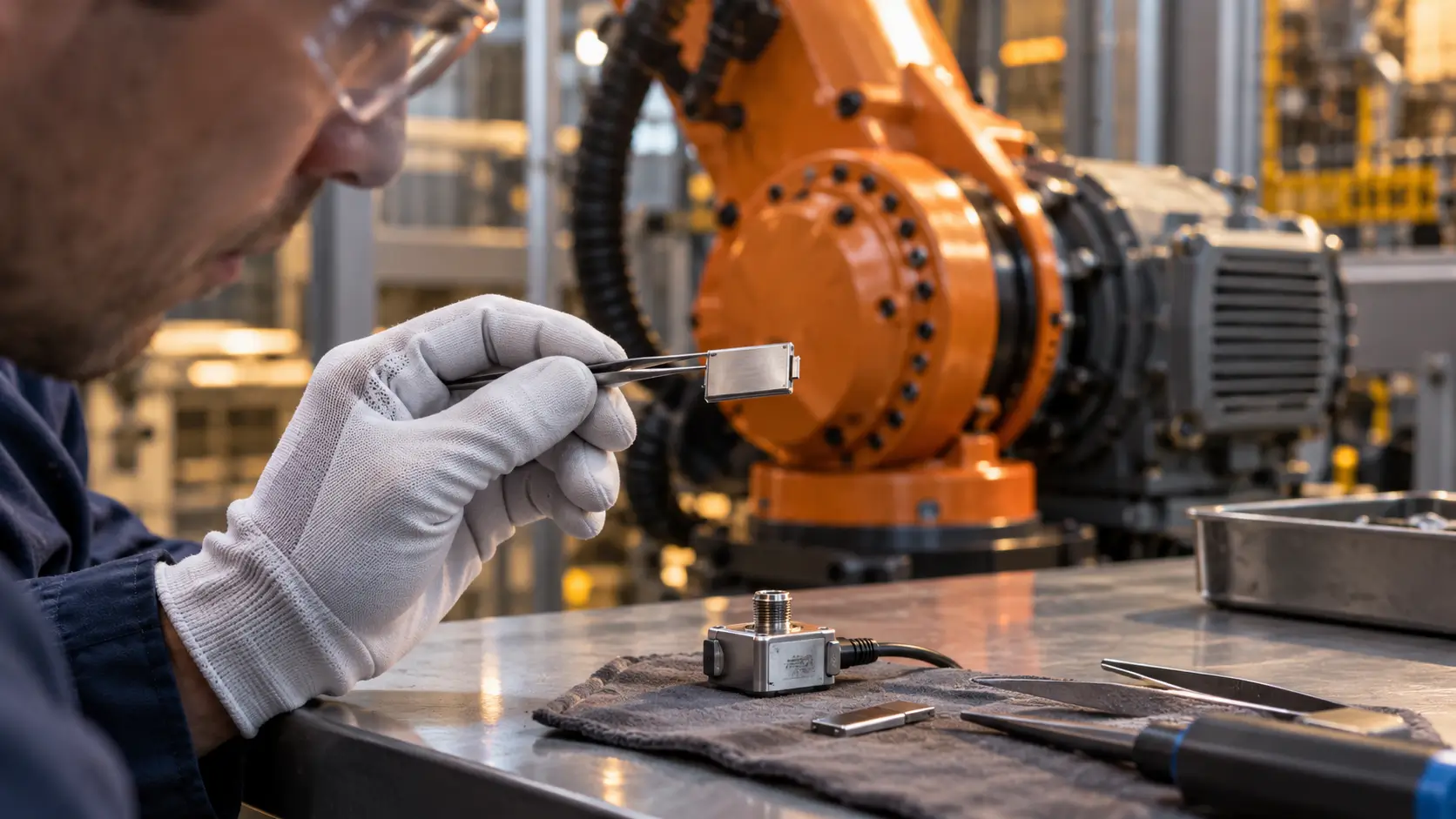
A battery placed near the motor of an industrial robot or inside a vehicle must sometimes operate in a heat that greatly shortens its life.
Panasonic Energy claims to have developed a small, solid battery capable of operating up to 150 °C. Announced on September 9, 2026, it is to be offered as samples between October and December.
His first market will not be electric cars. Instead, Panasonic targets industrial equipment and automotive sensors, where a small, hard-to-access battery can cost a lot more to replace than to buy.
Why replace liquid electrolyte?
A conventional battery uses a liquid electrolyte to transport ions between its electrodes. A solid battery replaces this liquid with a solid material.
This architecture can facilitate high temperature operation and reduce some risks associated with the presence of flammable liquid. However, it does not automatically render a battery indestructible or completely risk-free.
Panasonic points out in its [official technical presentation] (https://energy-note.jpn.panasonic.com/n/naba5e7551e05?hl=en) that liquid electrolyte batteries remain suitable for many uses. Instead, the company reserves the very solid technology to situations where its thermal resistance can justify a more complex cost or manufacturing.
Panasonic did not publish the exact electrolyte composition, capacity, voltage, energy density or number of cycles of its new model. It is therefore impossible to fully compare its performance with that of an existing industrial battery.
A temperature increased to 150 °C
The previous prototype of Panasonic could operate up to about 125 °C. The new version brings the announced limit to 150 °C, according to the Technology Director of Panasonic Energy cited by [Reuters] (https://www.reuters.com/business/energy/panasonic-energy-develops-solid-state-battery-that-can-operator-150-degrees-2026-09-09/).
This temperature does not necessarily mean that the battery can retain its full capacity for several years at 150 °C. Panasonic has not yet published its degradation curves, cycling results or precise test conditions.
The concept of "function" will also need to be clarified. A backup battery that occasionally provides low current does not experience the same stresses as a recharged and unloaded battery.
Robots that keep their memory
Industrial robots contain encoders that measure the position of their engines and joints. A small backup battery can retain some data when the main power is switched off.
However, the heat released by the engine reduces the lifetime of conventional batteries. When a battery has to be replaced, the company may have to stop the machine, open its mechanism and recalibrate its system.
Panasonic believes that a more resistant battery could space these interventions. The economic gain would then come less from the price of the pile than from the reduction of stops and labour.
Another proposed application is tire pressure monitoring systems. Rotation, braking, road temperature and the proximity of the wheels can create a difficult environment for their electronics.
The manufacturer also mentions the sterilization of certain medical equipment. Such use would, however, require final device-specific validations, certifications and approvals. The battery itself is not presented as an approved medical device.
A new prism format
Panasonic develops a small prismatic case, therefore rectangular, in addition to its models resembling button batteries.
According to the company, this form would give manufacturers more freedom to place the battery in a sensor or compact mechanism. It could also facilitate the replacement of existing components if dimensions and connections are compatible.
Panasonic says it wants to favour formats already used in industry and reuse part of its production equipment. This strategy may limit the necessary investments, but no manufacturing pace has been announced.
The first samples are to be shipped in the last quarter of 2026. Panasonic then aims at mass production one to two years later, also reports DigiTimes. It is a goal, not a guaranteed business date.
Prices and availability in Canada
Panasonic Energy did not provide any pricing, control capacity, or Canadian distributor for this battery.
The samples will be intended for manufacturers and industrial integrators rather than consumers. No Canadian clients or pilot projects have been announced.
The price may vary according to format, capacity, volume ordered, qualification tests, equipment, contract, distributor and region. No reliable amount in Canadian dollars is available.
Limits or Considerations
The battery is not yet produced in series. Its performance at 150 °C is currently based on Panasonic's statements.
Its capacity, power, charging time, service life, vibration resistance and behaviour in the event of perforation or short circuit are not public.
The interfaces between electrodes and solid electrolyte are also a challenge. A loss of contact can slow ion passage and decrease performance over cycles.
Finally, this small industrial model does not make it possible to conclude that Panasonic already has a solid battery suitable for electric cars. An automotive battery must provide much more energy, be manufactured by millions and operate in a very different temperature range.
Conclusion
Panasonic takes a pragmatic path: starting with a small battery whose heat resistance could solve a costly problem in robots and sensors.
The arrival of samples this autumn makes the project more concrete than just laboratory research. However, there is a lack of essential data to assess its sustainability and cost.
The real decisive step will come when customers have tested these batteries in their own machines and Panasonic will publish their performance after hundreds or thousands of cycles.