OroraTech and Eutelsat want to detect fires faster from space
OroraTech and Eutelsat prepare up to 96 infrared sensors in orbit to spot the lights earlier. This is their operation and their limitations.
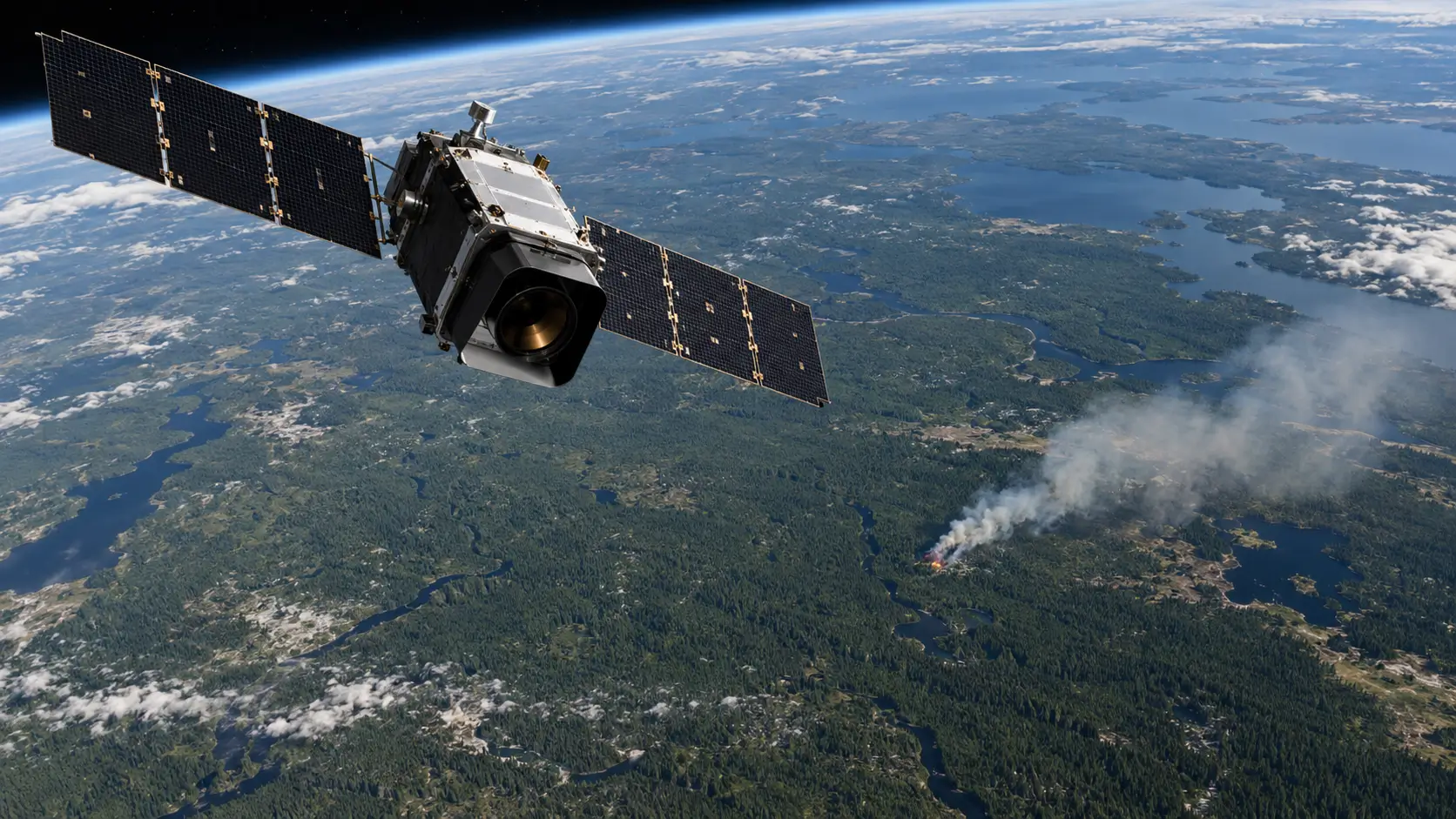
A fire that starts away from a road or community can burn for several hours before it can be seen. Thermal sensors placed in orbit can detect its heat even during the night or when smoke masks the ground.
On September 9, 2026, OroraTech and Eutelsat announced an agreement to install up to 96 of these sensors on future satellites in low Earth orbit.
Expansion could considerably reduce the time between two observations from the same territory. However, only 48 locations are reserved firmly; the remaining 48 remain an option and no specific launch schedule has been published.
Sensors carried by the satellites of Eutelsat
OroraTech will not necessarily build a complete satellite for each new instrument. Instead, its sensors will be "hosted payloads" on future satellites from Eutelsat.
The satellite then provides power supply, communications, orientation control and transport to orbit. OroraTech can add a thermal instrument without financing a separate space platform for each.
This approach could reduce costs and accelerate expansion. It also creates a dependence on satellite models, orbits and Eutelsat's renewal schedule.
(https://ororatech.com/resources/news-blog/eutelsat-and-ororatech-partner-to-deploy-up-to-96-thermal-infrared-payloads) covers 48 payloads and one option for 48 others. This means 96 possible sensors, not 96 already controlled satellites.
How does a satellite spot a fire?
An ordinary camera primarily measures visible light. A thermal infrared sensor is looking for the radiation produced by hot surfaces.
It can detect an abnormally hot spot during the night and through part of the smoke. Algorithms then compare the temperature, position and evolution of the signal to distinguish a potential fire from the surrounding terrain.
OroraTech states that its current network includes sensors on 14 satellites and that its platform combines more than 35 satellite and terrestrial sources. The company also uses artificial intelligence to detect anomalies and estimate the spread of a fire. These figures and capacities are presented on the manufacturer's website and not all are independently verified results.
A satellite does not remain constantly above the same location. The more sensors the network has spread over different orbits, the faster it can revisit a region.
OroraTech estimates that the agreement with Eutelsat could increase its compliance capacity by almost 500 %. This statement should be verified when orbits, resolution, the number of sensors actually launched and their readiness are known.
Technology already used in Greece
The project is not entirely experimental. Four satellites on fire surveillance were launched for Greece in May 2026.
According to Associated Press, their sensors have been designed to signal fireplaces about four metres wide. The system combines orbital observations with fire service tools.
The [Financial Times] (https://www.ft.com/content/b067244e-744d-49ae-89e7-eb47ba61ee87) reports that the first images were received in June and that the system was due to become fully operational in September. The training of teams and the integration of alerts into interventions, however, remain as important as the satellites themselves.
A hot spot observed from space does not automatically indicate the presence of a hazardous forest fire. Industrial installations, sun-heated surfaces or other phenomena can produce similar signals. Validation by the authorities, ground cameras, aircraft or witnesses remains necessary.
Clearly relevant to Canada
Canadian forests cover immense territories that are sometimes difficult to monitor by towers, patrols or terrestrial cameras.
OroraTech has a Canadian presence and indicates its services to the country. The new network could therefore potentially improve the coverage of boreal regions and remote infrastructure.
However, no province, federal agency or Canadian organization was announced as a client of these new payloads. It should not be assumed that alerts will automatically be integrated into Canadian fire management systems.
The actual value will also depend on the speed with which an observation is transmitted, analysed and communicated to the teams able to intervene.
Prices and availability in Canada
OroraTech and Eutelsat have published neither the total cost of the partnership nor the commercial rate for accessing data from the new sensors.
It is a service primarily intended for governments, emergency services, infrastructure operators and forest companies rather than a product sold directly to individuals.
The price may vary depending on the area monitored, frequency of observations, resolution, warning times, analytical functions, computer integration, contract duration and region. No reliable Canadian dollar rates are available.
Limits or Considerations
The future sensors are not yet in orbit. Their resolution, sensitivity, orbits and detailed launch dates are not public.
Thick clouds may limit some thermal observations. Orbital passages also lead to periods without new images, although a larger constellation may reduce these intervals.
Algorithms can produce false alarms or miss a fire too small, covered or located between two passages. Space detection thus completes the terrestrial and aerial means without replacing them.
Finally, early warning does not guarantee early intervention. Winds, terrain accessibility, available resources and team safety always determine the possible response.
Conclusion
By installing its sensors on the future satellites of Eutelsat, OroraTech wants to transform a specialized network into a large-scale thermal infrastructure.
The host payload formula could multiply the observations without building a separate satellite for each camera. It is particularly interesting for large and remote forest areas.
It will now be necessary to know the launch schedule, check the announced 500 per cent gain and demonstrate that the alerts arrive quickly and accurately enough to change the ground response.