LG FLiPP: manufacturing OLED screens without metal mask
FLiPP replaces the metal masks of OLED screens with photolithography. LG promises more light, durable and energy-efficient panels.
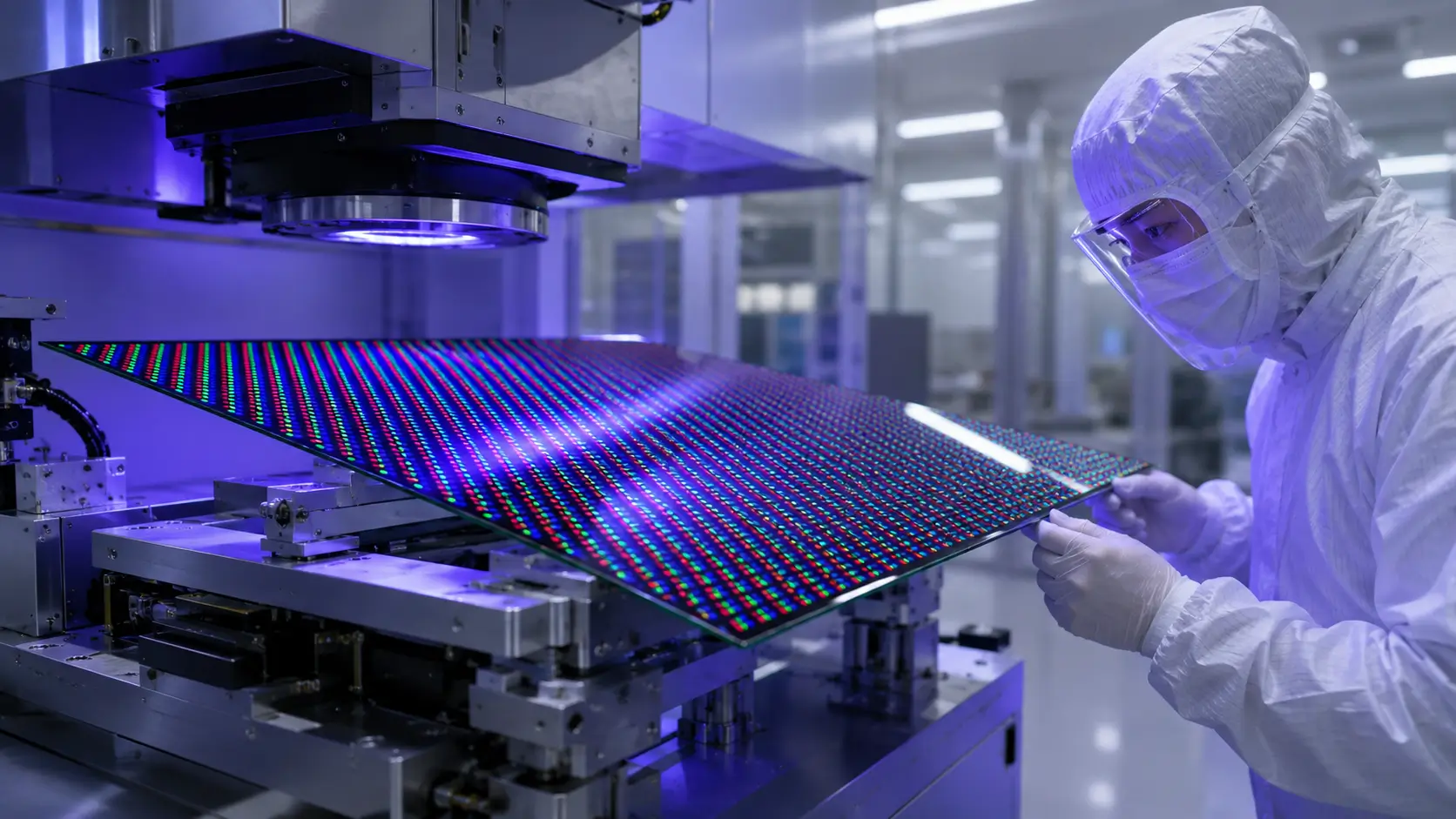
OLED screens produce their own colors and can offer perfect blacks, but their manufacturing remains complex. To accurately place red, green and blue pixels, manufacturers usually use large metal plates pierced with tiny openings.
LG Display wants to replace these stencils with FLiPP, a process unveiled on August 19, 2026 that borrows a technique from semiconductor manufacturers: photolithography.
The result could be brighter, more durable and less energy-efficient panels. These gains, however, come from internal LG testing and are still to be reproduced on an industrial scale.
The problem of metal masks
A thin metal mask, or FMM, works like an extremely accurate stencil. Red, green and blue organic materials are evaporated through its openings to form the subpixels of an OLED display.
The method works well on small panels, but becomes more difficult to apply when the surface increases. A large mask can subside slightly under its own weight, which complicates alignment and can mix colors.
Each new dimension or definition also requires a suitable mask. On large sheets of glass used to make multiple screens, mechanical stresses may force the manufacturer to divide the substrate before certain steps.
The official release of LG Display presents FLiPP as a solution to these constraints. The acronym means "FMM-Less innovative Pixel Patterning", an innovative process for the formation of pixels without a fine metal mask.
Ultraviolet light to draw pixels
FLiPP deposits the organic materials of each colour in successive layers. A photosensitive resin is then applied to the surface.
Ultraviolet light hardens areas that must be preserved. A chemical treatment then removes unnecessary portions. The operation is repeated for red, green and blue pixels.
This method is more like the photolithography used in the manufacture of integrated circuits than the traditional stencil deposit.
LG states that it manufactured a maskless OLED on an eighth generation glass sheet measuring approximately 2.2 by 2.5 metres, without having to cut it in half. A 27-inch demonstration panel was also presented at IMID 2026.
UBI Research confirms the existence of the prototype and stresses that commercial success will now depend on the ability to maintain a stable production yield.
Significant gains, but still internal
Compared to panels made with a mask under conditions that LG described as identical, FLiPP would increase the surface occupied by subpixels by approximately 55%.
The manufacturer announces:
- a brightness multiplied by 1.6;
- a lifetime multiplied by 2.4;
- a reduction of 13%;
- improved use of glass sheet by up to 64% for comparable portable panels.
These results were not accompanied by absolute candelas values per square metre, a number of operating hours or a complete test protocol. Nor do they mean that a future screen will automatically offer all the maximum payouts at the same time.
The Verge states that no production or marketing date has been announced. These figures should therefore be regarded as statements by the manufacturer obtained during development.
#1 Screens from 1 to 100 inches in theory
Since FLiPP does not depend on a metal mask corresponding to each definition, LG estimates that it can adapt the process to screens ranging theoretically from 1 to 100 inches.
The company aims primarily at computer applications, including tablets and monitors. It then considers portable devices, virtual and augmented reality devices and large-scale televisions.
This flexibility could produce larger RGB OLED panels. In this architecture, each subpixel emits its own color directly, unlike panels that first generate white or blue light before transforming it with filters or quantum points.
(https://www.tomshardware.com/monitors/lg-display-introduces-new-oled-deposition-technique-that-uses-lithography-instead-of-metal-masks-flipp-photolithography-delivers-1-6x-brightness-and-2-4x-longer-lifespan) that this combination could improve color volume. However, the media points out that LG is not the only company working on maskless OLEDs: Japan Display has its eLEAP process, while Visionox and TCL are developing other methods.
The novelty claimed by LG concerns more precisely the use of an entire 8.5th generation sheet with its own FLiPP process, and not the universal invention of the mask-free concept of "DOLED".
Prices and availability in Canada
FLiPP is not a product offered directly to consumers. LG Display sells panels to other manufacturers, who then integrate them into their devices.
No prices, no commercial range and no Canadian availability are announced. Consumers cannot purchase a FLiPP screen yet.
The possible price will depend on plant performance, panel size, definition, device manufacturer, retailer, promotion and region.
Limits or Considerations
A functional prototype does not demonstrate that a process can immediately produce millions of panels at a competitive cost.
The steps of photolithography and chemical treatment add their own complexity. Manufacturers will have to control defects, contamination, colour alignment and uniformity on large surfaces.
FLiPP does not automatically remove permanent marking, or burn-in. Better durability of materials may reduce risk, but no independent ageing test has been published.
Finally, UBI Research reports that LG is still studying its investment strategy. The dates for new equipment are therefore not an official marketing schedule.
Conclusion
FLiPP attacks less to the image displayed than to the way to build the screen itself.
By eliminating the metal mask, LG could increase the light surface of pixels, use larger sheets of glass more efficiently and produce more OLED RGB formats.
The 27-inch panel shows that the process exceeds the simple concept. There is now a need to verify the returns, costs and reliability of mass production.
If these obstacles are overcome, FLiPP could eventually create more luminous and durable OLED screens. For the moment, there is still a promising industrial technology, not yet a product that can be purchased.