
HyperX Cloud Alpha Air: an open helmet that doesn't want to give up bass
HyperX Cloud Alpha Air adopts an open design to expand the sound scene without sacrificing bass. Prices, impressions and limits to know.
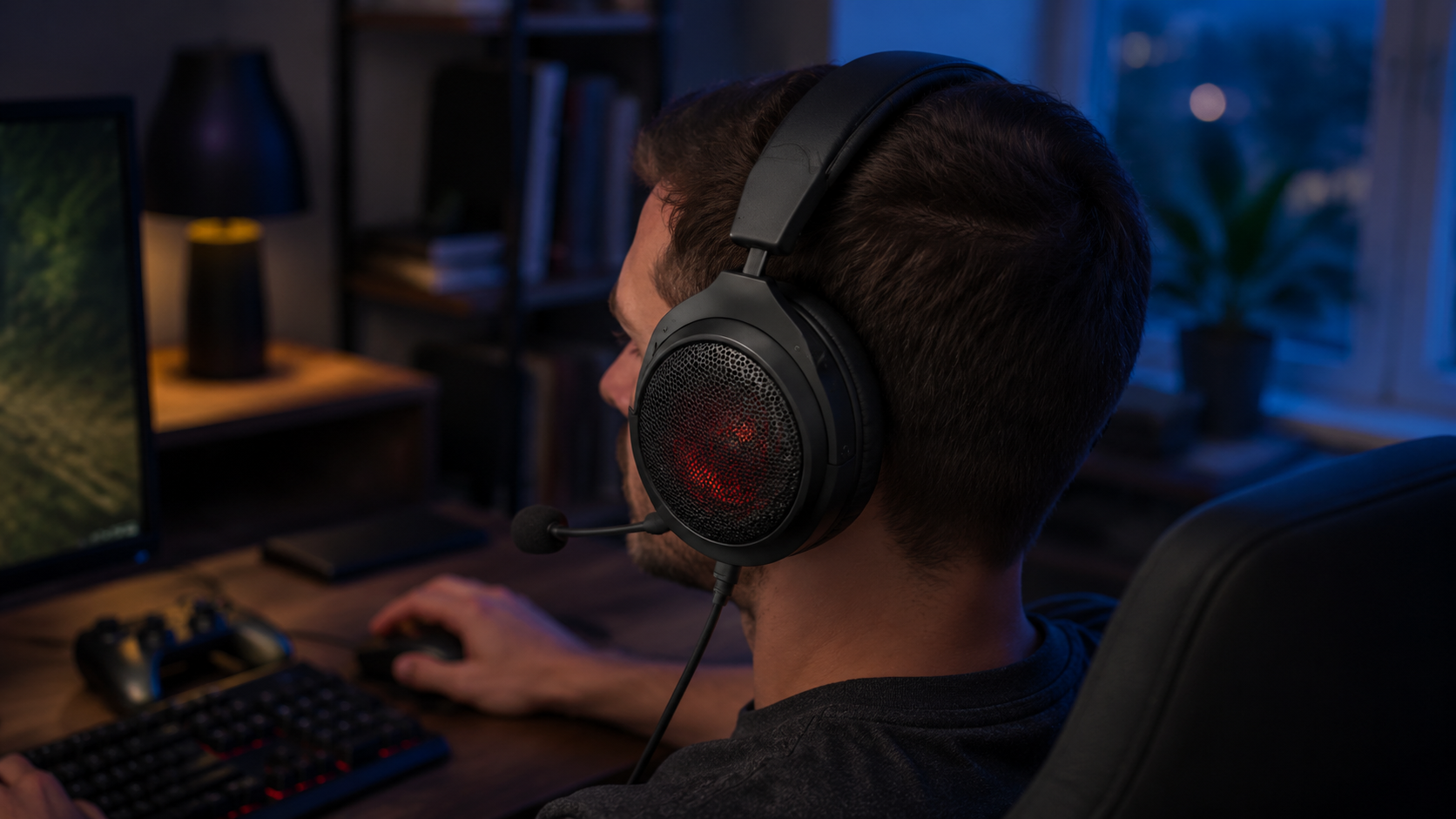
Open helmets are appreciated for their spacious and natural sound, but they usually lose some impact in bass. HyperX is trying to resolve this compromise with the Cloud Alpha Air, its first open game helmet, unveiled on August 20, 2026.
The manufacturer adds a mechanism called Bass Tube. The first shots confirm that the helmet actually works, but they do not yet agree on the effectiveness of this innovation.
What an open helmet really changes
On a traditional closed helmet, the outer shell partially imprisons the air behind the speaker. This construction promotes insulation and can strengthen bass.
The Cloud Alpha Air replaces this hull with a cellular metal grid. Air and sound can circulate through headphones, usually giving the impression that instruments, dialogues and effects come from a wider space.
In a game, this sound scene can facilitate the perception of the environment and direction of certain effects. HyperX states that its helmet improves the location of distant steps and sounds. This claim is from the manufacturer and has not yet been confirmed by independent comparative measures.
The opening also has significant disadvantages. The player hears more the noises of the play, while people nearby can hear what is playing in the helmet. This model will therefore be better suited to a quiet room than to public transport, a shared office or a noisy competition.
A red tube to strengthen bass
Behind each grid is a 40 mm red dynamic transducer. A central conduit, called Bass Tube, must, according to HyperX, preserve the bass normally attenuated by an open construction.
The first impressions are shared.
Engadget reports deep bass, controlled and sufficiently present to highlight serious effects without crushing mediums and acutes. However, the reporter states that he did not observe a clear competitive advantage during his short takeover.
PCWorld got a different result. His journalist noticed a clear loss of bass compared to a Sennheiser HD 6XX helmet, despite the presence of Bass Tube. However, he saw some discreet details and his own voice better.
These observations were made in short-term demonstrations. They do not replace a comprehensive assessment of frequency response, distortion and spatial accuracy.
#A fully wired design
Cloud Alpha Air does not integrate Bluetooth connection or wireless transmission. It uses a 3.5 mm audio cable, eliminating charging and latency associated with a radio link, but limiting freedom of movement.
The box also includes a computer extension with separate sound and microphone outlets, as well as an adapter compatible with USB-A and USB-C ports.
Its impedance of 34 ohms should make it possible to use with many devices. However, Engadget found the volume slightly low by plugging it directly at the 3.5 mm output of a computer. The supplied USB adapter or a separate digital-analog converter could be better suited in some cases.
The helmet has a removable microphone, a volume wheel and a deafening control. Its equalization can be customized in NGENUCY, a software officially offered on Windows 10 and Windows 11.
The large foam pads covered with ultrasweed were considered very comfortable by Engadget. PCWorld found them rather hot, to the point of possibly reducing the ventilation advantage of an open helmet. The comfort should therefore be evaluated over long sessions.
Prices and availability in Canada
HyperX plans to market the Cloud Alpha Air in September 2026 at the announced fixed price of US$149.99**.
No Canadian prices or calendars were published at the time of the audit. The product did not yet appear in the Canadian HyperX store. Therefore, it should not be assumed that it will be offered to the country from day one.
The final price may vary depending on the retailer, promotion, taxes, accessories and region. A possible conversion to Canadian dollars will depend on the official rate chosen by HyperX and not only the exchange rate.
Limits or Considerations
The tests published so far are brief, not final evaluations.
The effectiveness of Bass Tube remains uncertain, as the two journalists obtained opposite impressions. The microphone quality, cable durability, weight, full frequency response and actual insulation have not yet been independently documented.
The helmet also lets in the ambient sounds and lets escape its own sound. This feature is part of its design and cannot be corrected by software setting.
Finally, the lack of wireless connection might seem restrictive for a model of this price, especially when wireless closed helmets are offered in a comparable range.
Conclusion
The Cloud Alpha Air transposes the simple formula of HyperX headsets into a category closer to high-fidelity listening.
Its open construction could offer a pleasant sound scene to players installed in a quiet room. Its true distinction, however, will depend on Bass Tube: if this conduit really keeps the bass without sacrificing clarity, HyperX will have found an interesting compromise.
The conflicting impressions show that it will be better to wait for full testing — or listen to the helmet itself — before spending $149.99.