CS‐4 Cerebras: three giant processors to speed up the responses of the AI
Cerebras CS-4 brings together three processors of the size of a silicon slice to accelerate the AI. Here is its architecture, its promises and its limits.
Large artificial intelligence models can produce elaborate responses, but their speed depends heavily on the hardware that moves data between memory and computing units.
Cerebras proposes a radically different approach with CS-4, a system unveiled on August 18, 2026. Instead of bringing together hundreds of conventional graphics processors, this server bay contains three processors almost as large as a full slice of silicon.
A processor much bigger than a traditional chip
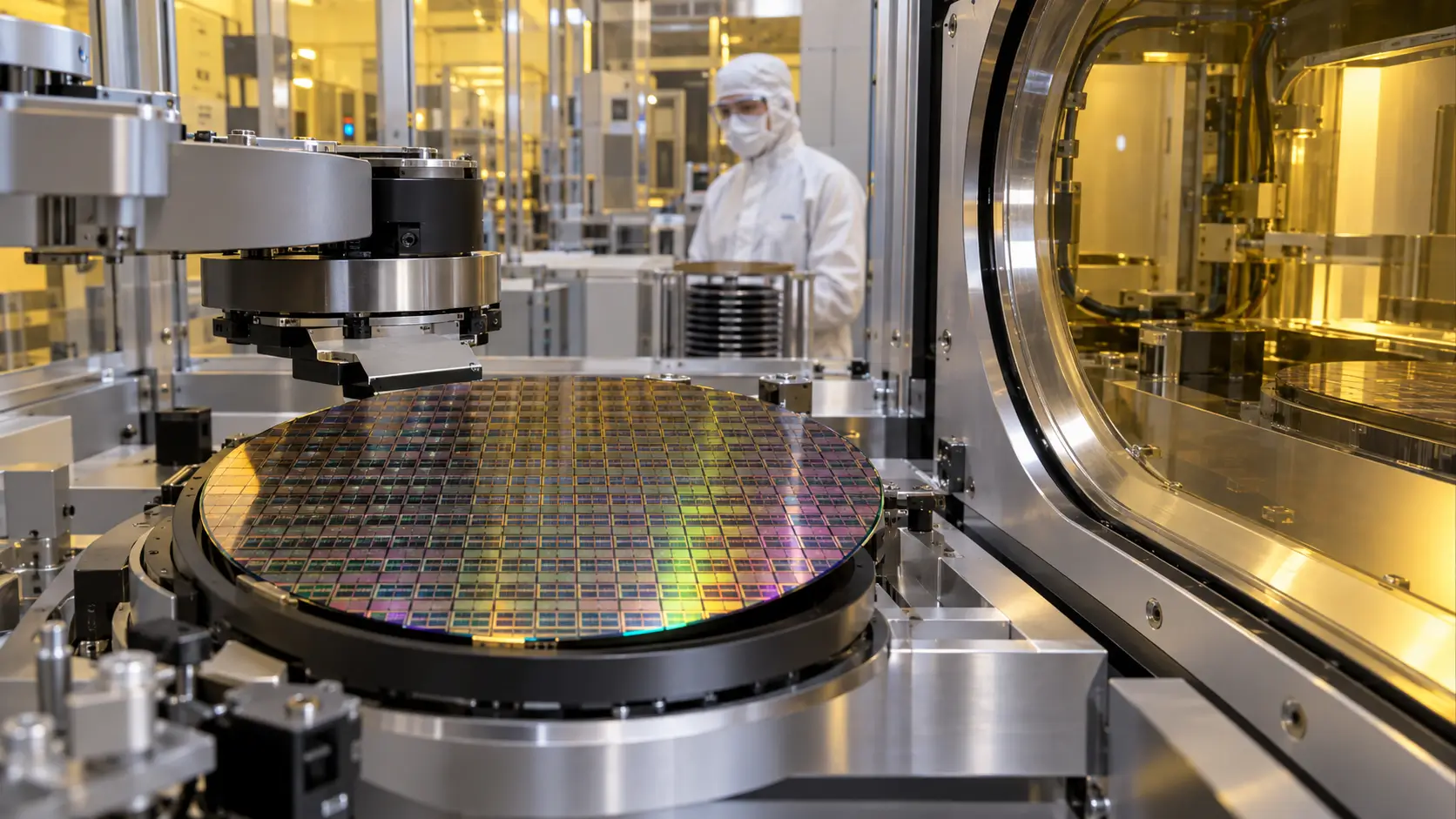
The CS‐4 uses three WSE‐3 Turbo processors. Each is about 46 225 mm2 and consists of four trillion transistors, 900,000 specialized cores and 44 GB SRAM memory directly integrated with silicon.
This proximity between calculation and memory is the main advantage sought. In a cluster of graphics processors, data must continuously flow between chips and different levels of memory. These transfers consume energy and add latency.
With its one slice scale processor, Cerebras keeps more data at the same location. Reuters explains that this architecture primarily aims at inference, i.e. work done when an already trained model generates a response.
CS-4 does not automatically make an AI more accurate or smarter. Rather, he seeks to have his answers produced faster.
A new bay around three removable modules
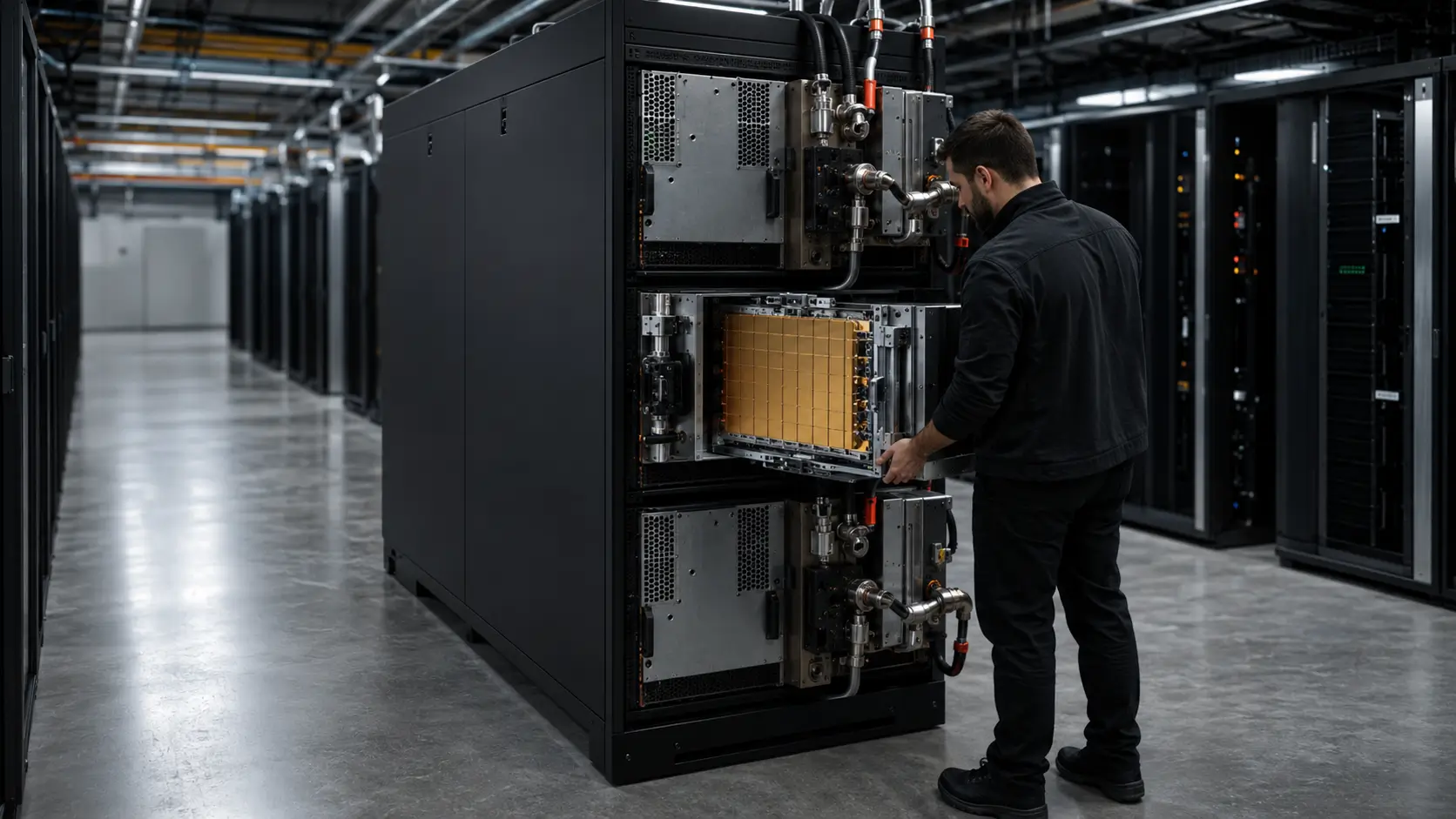
The CS-4 is the first system based on Cerebras' Nexus architecture. Its three processors are installed in removable modules located at the back of the bay. Each module brings together the processor, power supply, liquid cooling, input-output connections and control electronics.
According to [Cerebras technical presentation] (https://www.cerebras.ai/blog/introducing-cerebras-cs-4), this design uses 50% fewer components than the previous generation and would reduce installation from several days to a few hours. These benefits are manufacturer's claims that will need to be confirmed during actual deployments.
The new system also brings electrical conversion closer to the processor. This allows the WSE‐3 Turbo to be powered more strongly and double its operating frequency compared to the previous WSE‐3.
However, this is not a new generation of silicon. The Register emphasizes that the WSE-3 Turbo maintains the manufacturing process at 5 nanometres of TSMC, the same number of transistors, hearts and memory as its predecessor. The gain comes mainly from power supply, cooling, interconnections and more intensive use of the existing chip.
#Awesome numbers to interpret carefully
With its three processors, the CS‐4 announces a total power of 750 petaflops, a memory bandwidth of 129.6 petabytes per second and 7.2 terabits per second for input-outputs.
However, the figure of 750 petaflops is based on sparse FP16 calculations, where some of the values are ignored. It cannot be compared directly to the dense performance or FP4 put forward for certain graphics processors.
Cerebras states that the CS‐4 can produce chips up to 30 times faster than graphics processors. The company also claims up to ten times as much flow per watt as the CS-3.
The comparison "up to 30 times" combines artificial analysis results and internal tests selected by Cerebras. It therefore does not describe all the workloads, all the models or all possible configurations.
Another claim evokes over 1,000 chips per second for models exceeding ten trillion parameters. Cerebras itself specifies that this value is extrapolated from its internal tests. No public model of this size has yet been able to reproduce it independently.
Separate reading of the question and writing of the answer
The CS-4 can operate in a so-called disaggregated infrastructure. A graphics processor or specialized chip begins by analyzing user demand, a step called pre-filling. The Cerebras system then supports decoding, i.e. the progressive generation of the response.
Cerebras includes compatibility with AMD Instinct accelerators and Amazon Trainium chips. This approach avoids imposing the same architecture at all stages of processing.
Prices and availability
The first deliveries of CS-4 are expected to begin before the end of the third quarter of 2026. This is equipment for data centres, cloud providers and organisations operating very large models.
Cerebras did not provide public prices or ranges for the main configurations. The systems are sold on quotation with their infrastructure, cooling, software and deployment services.
No Canadian-specific availability was announced. An interested Canadian organization should therefore directly verify the possibilities for purchase, accommodation, installation and support. The cost may vary depending on the configuration, capacity, service contract, region and data centre needs.
Limits or Considerations
The CS-4 requires power supply, liquid cooling and specialized infrastructure. It is neither a conventional server nor a device that can be installed in a small business.
Most of the most spectacular figures come from Cerebras. Independent tests will have to compare flow, latency, total consumption, cost per token and reliability over a long period of time.
The more intensive use of the same silicon also increases the electrical power to dissipate. Response efficiency may improve even if absolute berry consumption remains very high.
Finally, the Cerebras software ecosystem is much smaller than that of Nvidia. Compatibility with cloud models, tools and providers will be as important as gross performance.
Conclusion
The CEREBRAS CS-4 demonstrates that an AI infrastructure does not necessarily have to replicate the traditional cluster model of graphic processors.
Its three giant processors, ultra-fast memory and new modular architecture could significantly reduce the time needed to generate some responses. This could make voice assistants, software agents and programming tools more responsive.
The potential is real, but the assertions of speed and efficiency will have to be assessed based on the model used, total consumption and cost of deployment. CS-4 accelerates the calculation; it does not guarantee a better response or a more reliable AI.