Voxel wants to become the robot that sets the house straight
Voxel wants to clean up the house and find the lost items. This is what this robot promises at $20,000 US, still at the prototype stage for 2028 in the United States.
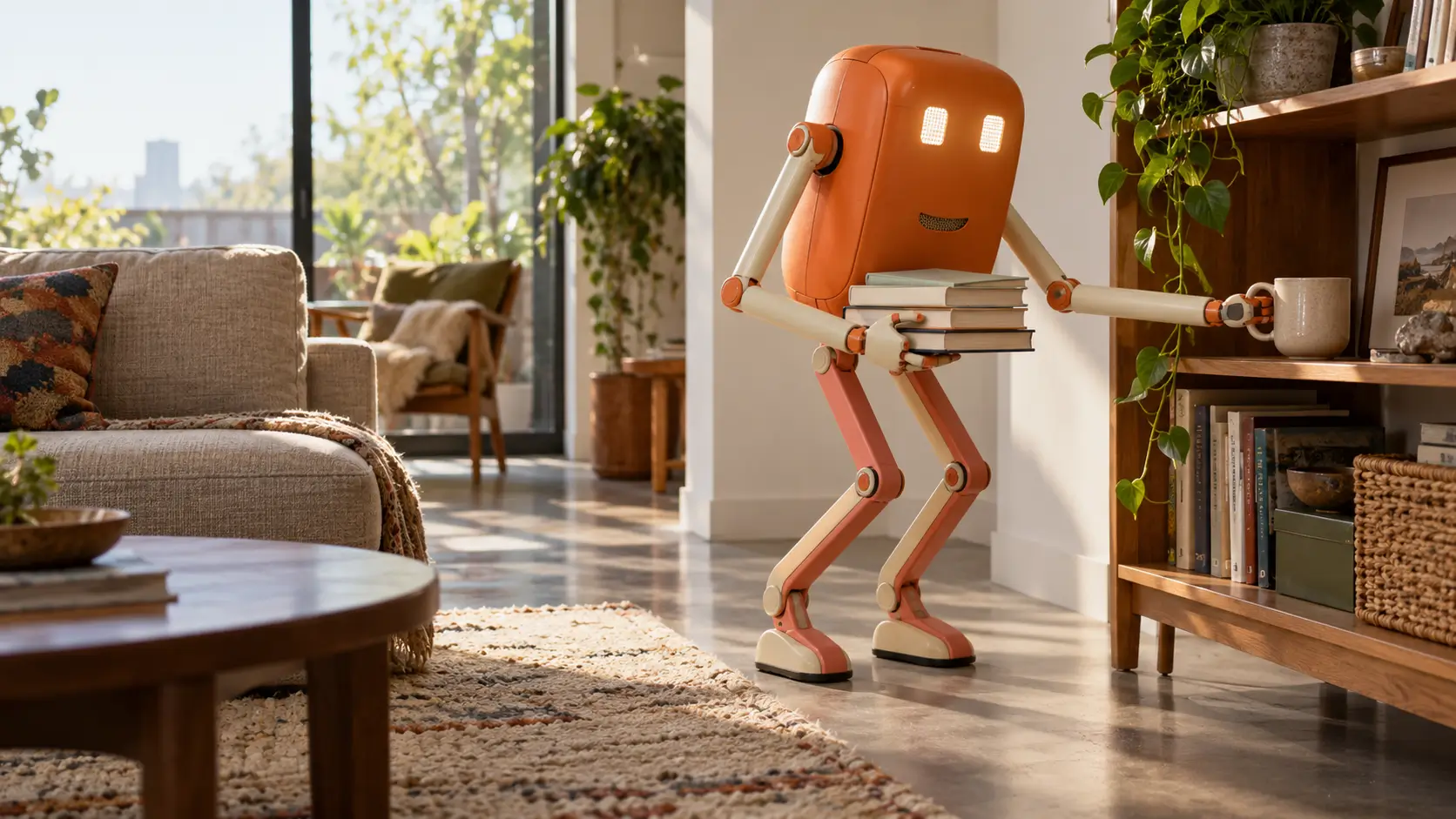
A robot that stores the living room, brings back the keys and remembers where he saw the remote control: this is the Voxel Series-1 proposal, unveiled on October 20 by the young New York company Tuesday Labs. The prototype is charming and its functions target very real irritants. However, it is necessary to keep the head cold: delivery is not planned until 2028, the final price is not fixed and reservations are offered only in the United States.
A biped butler designed for small disorders
Voxel does not try to reproduce a human perfectly. Its orange and pink body combines a rectangular head and torso, small eyes with pixels, long arms and Z-shaped legs. According to the Tuesday Labs Official Fiche, each arm offers seven degrees of freedom with a motorized wrist, while the pliers only have a degree of freedom. A pair of stereoscopic RGB cameras and a wide-angle camera are used to perceive the room.
The manufacturer claims to train Voxel to return the items to their place, bring back a book or drink, water plants and indicate where he saw an object for the last time. The Verge stresses that the clamps remain much simpler than robotic fingertips and that Tuesday Labs hardly describes in detail autonomous performance. In other words, these tasks are manufacturer's objectives, not the results of an independent domestic test.
A robot that relies as much on behavior as on strength
Perhaps the most interesting difference is not mechanical. Founder Rosalind Shinkle, a former robotics engineer at Boston Dynamics, wants to give Voxel a coherent and predictable behavior. She explained to [Fast Company] (https://www.fastcompany.com/91626430/this-robotic-butler-is-part-boston-dynamics-part-pixar) that animators who worked at Pixar participated in the creation of her movements and personality.
The idea deserves attention: in a house, trust also depends on the ability to understand what a machine will do. A robot that hesitates, looks at an object before grasping it or clearly indicates its intention could be less confusing than a fast but opaque machine. There is still no evidence that this approach will make Voxel safer or more effective; This is a design choice, not a scientific validation.
Reservation, price and availability
Tuesday Labs requests a refundable deposit of US$200. It is not a purchase or a sales contract. The booking conditions estimate the robot price at US$20,000, but specify that this amount is not contractual and may change. No reliable Canadian prices were announced.
The first deliveries are targeted for 2028, possibly later, and could start in some parts of the United States only. Reservations currently require an American delivery address: Voxel is not available in Canada. The final price may vary depending on the configuration, taxes, delivery costs, method of payment, region and commercial conditions then in force.
Limits and Considerations
Tuesday Labs' contract document explicitly describes Voxel as "development concept and prototype". The company plans to substantially review the equipment; The appearance, components, functions and characteristics could therefore differ from the model presented. Production is not complete and the aircraft has not yet obtained the required authorization from the US FCC.
Privacy will also need to be examined. A robot that maps parts, observes objects and memorizes their location necessarily deals with intimate home information. The product page consulted does not detail where this data will be kept, how long it will be kept, or what functions can work locally. These are key issues before any recommendation.
Finally, no complete independent evaluation yet demonstrates that Voxel can reliably store a house without supervision. Stairs, animals, children, liquids, fragile objects and unforeseen situations present much more difficult challenges than a controlled demonstration.
Conclusion
Voxel offers a more modest and perhaps more credible vision of the domestic robot: first find, report and store rather than promise to do everything. Its expressive design is original, but the final product remains distant and can change a lot. For the Canadian public, it is today a prototype to follow, not a purchase to plan.