REAL Aura: Android XR takes the form of glasses at $1,829
The XREAL Aura glasses arrive in Canada with Android XR, a separate computing module and a price of $1,829 to $2,149 CAD. Here are their real limits.
XREAL has just put a price and a timeline on an idea that has long been limited to demonstrations: a space computer worn like glasses. The Aura will first arrive in Canada, the United States, Japan and South Korea, with deliveries promised before the holidays. But they are neither discrete glasses for the whole day nor a product already offered to all.
Goggles, plus a pocket computer
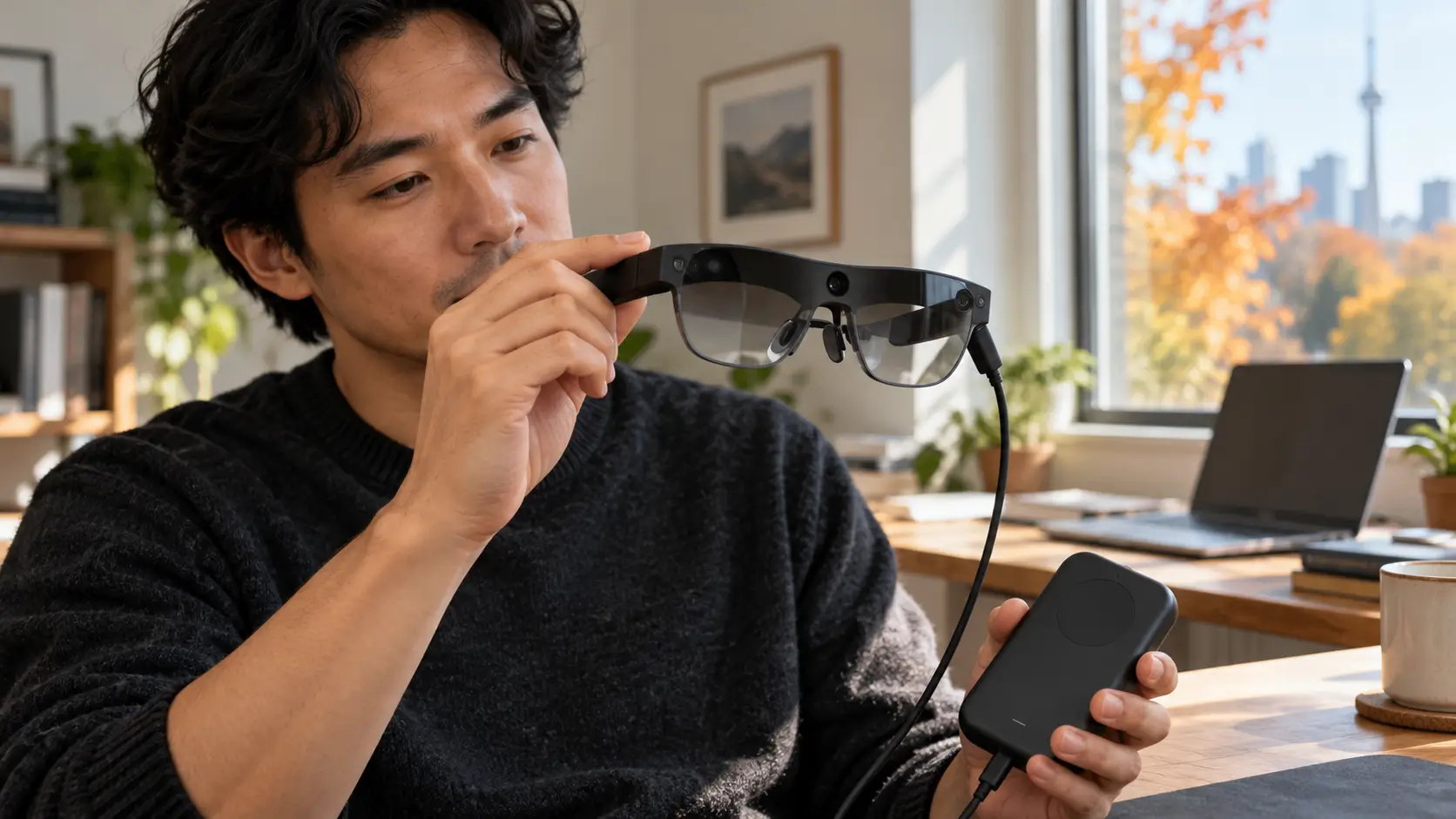
The Auras use transparent lenses: you can directly see the real world while two Sony micro-OLED screens overlap digital windows. The [XREAL Canadian Fiche] (https://www.xreal.com/ca/aura) provides a definition of 1,920 × 1,200 pixels per eye, a maximum refresh rate of 120 Hz and a diagonal field of vision of 70 degrees. Two cameras are used for space and hand tracking, while a high definition central camera is accompanied by a privacy light.
To keep the glasses under 95 g, the processor and battery are placed in a cable connected module. This deck combines the Snapdragon Reality Elite platform, a 4,455 mAh battery, a touchpad, a fingerprint reader, the 6/6E Wi-Fi and Bluetooth 5.3. The glasses also include four microphones and an audio system set by Bose. The charging can reach 65 W, according to XREAL.
This separation reduces the weight and heat on the face, but it imposes a cable and a second device in the pocket. In an earlier test of about 20 minutes, Engadget found the clear and luminous display as well as reliable hand tracking, while noting that the calculation module became hot in an already very hot outdoor environment. These are first impressions, not an endurance test of the commercial model.
Android XR wants to replace more than just a screen
The module runs Android XR with Google Play. So you can open Android apps in space, use hands, voice or touchpad, then add a keyboard, mouse or Bluetooth controller. A computer can also be connected to DisplayPort mode to turn glasses into an external screen.
Gemini must offer visual assistance functions, with user permission. For now, the real value will depend mainly on apps adapted to Android XR. XREAL states that it aims for work, entertainment, games and creation, but these uses have not yet been evaluated in a complete independent test of the final product.
A trial of Android Authority reports convincing gesture navigation and readable display. However, another specialized test observed a slight distortion of the image during head movements. These preliminary experiments suggest promising material, without yet answering questions about real autonomy, comfort for several hours or software stability.
Prices and availability in Canada
The news release of October 7 sets the 12GB model of RAM and 256GB of storage to $1,829 CA, and 16GB/512 GB to $2,149 CA. Prices may vary according to configuration, taxes, promotions, retailer and region.
The grade is important: complete pre-orders are currently reserved for those who had made a deposit before 7 October. The Canadian store displays the product and XREAL says general orders will open in the coming weeks, with shipments before the holidays subject to production, quality controls and logistics. No specific Canadian date is yet published.
Limits or Considerations
The price exceeds that of several laptops, and the Auras remain visibly more massive than ordinary glasses. They do not offer eye-tracking: the interaction rests rather on the hands, the voice and the touch module. Corrector lenses require inserts sold separately.
The camera turned outwards also raises privacy issues, despite its visionary. Finally, the Android XR ecosystem is young. The compatibility announced with Google Play does not guarantee that an app designed for a phone will be pleasant or fully functional in a three-dimensional space.
Conclusion
The XREAL Aura are less interesting because they promise a spectacular future than because they finally assemble a transparent screen, a space tracking and a consumer operating system in a tariffed product for Canada. Their separate module design is a credible compromise between power and weight, but cable, high price and the emerging ecosystem are primarily intended for enthusiasts and developers. We'll have to wait until the model is tested before we know whether this facial computer can actually replace a monitor — or whether it will remain an excellent pocket screen.