HOVERAir VERSA: a pocket camera that can take off
HOVERAir VERSA combines stabilized 4K camera and 230 g autonomous drone. These are his functions, his price, his promises and his real limitations in Canada.
Filming a hike usually requires choosing between a stabilized camera held by hand and a drone able to follow the subject. HOVERAir is trying to bring these two tools together with VERSA, a modular pocket camera whose fundraising campaign was launched on 18 August 2026.
The idea is simple: use the camera as a small portable pod, then add its set of wings to get a self-contained flying camera. The proposal is original, but several performances remain to be confirmed outside the manufacturer's demonstrations.
One camera, two ways to film
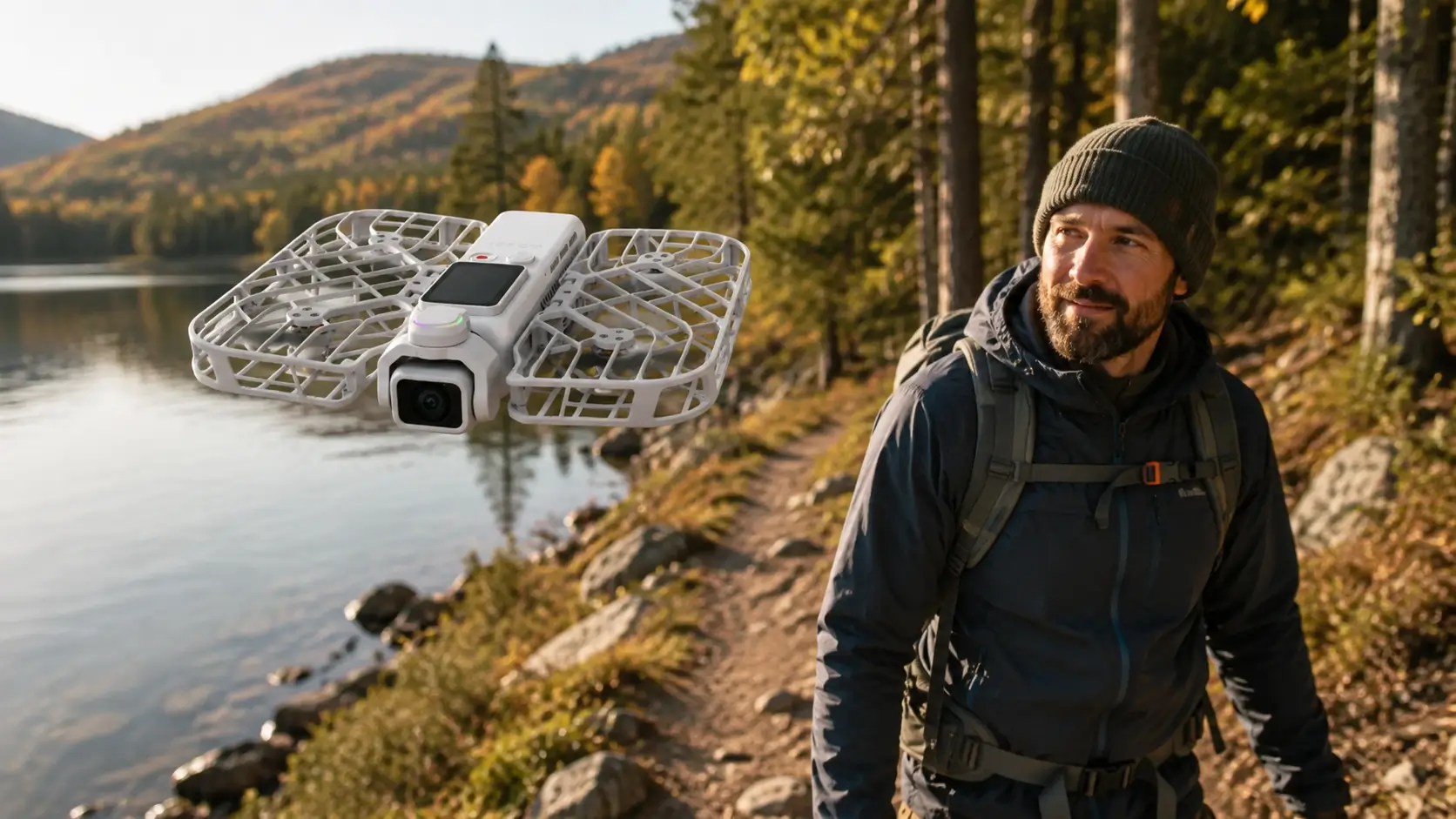
VERSA rests on a camera mounted on a three-axis mechanical pod. In portable mode, it is used to create self-portraits, moving planes and stabilized sequences without a telephone.
The addition of the Flight Kit deploys two large cages protecting four propellers. The device can then take off and land in the hand, automatically track a person and perform predefined movements such as Orbit, Birds Eye and Zoom Out. HOVERAir presents the system as a stand-alone camera that does not require radio control for its current functions.
This approach could be of interest to travellers, families and creators working alone. Above all, it avoids transporting two cameras whose colours, framing and files must then be harmonized.
What features announce
The Indiegogogo Campaign shows a 4K recording at 60 frames per second, a 10 bit color depth, a maximum speed of 36 km/h and more than 10 automated flight modes.
HOVERAir also announces a mass of 230 g, aerial range up to 14 minutes, level 5 wind resistance and a dynamic range of 17.5 diaphragms. These figures come from the manufacturer and have not yet been validated by complete independent tests.
The value of 17,5 diaphragms should be taken with caution. It is not yet clear from the published documents how it has been measured. There is also conflicting information on sensor size: some launch documents mention a 1/1.3-inch sensor, while one DroneXL analysis points out that this data did not appear clearly in the available official specifications.
From automatic tracking to 3D reconstruction
VERSA uses subject recognition to adjust the framing and track its movements. A function called AI Composition must automatically choose a composition, while 3D Worlds is presented as a means of capturing and reconstructing explorable scenes in three dimensions.
These functions are announced by HOVERAir. Their accuracy, processing time, compatible devices and export possibilities have not yet been fully evaluated independently.
Prices, availability and location in Canada
VERSA is proposed through crowdfunding and not through traditional Canadian marketing. A promotional price equivalent to US$ 449 was provided for a launch offer, but the complete grid of the main configurations was not published in sufficient clarity to establish a reliable range.
Therefore, there is no confirmed range in Canadian dollars. The final amount could vary depending on the package chosen, the exchange rate applied by the platform, delivery fees, taxes, import duties, promotions and the region.
HOVERAir states that the Indiegogo orders are available worldwide and plans to be distributed to some retailers in the fall of 2026. However, this does not confirm the shipment of each package to Canada or a locally administered warranty.
If the actual take-off weight remained within 250 g, VERSA would normally fall into the Canadian category of microdrones. Transport Canada specifies that a drone of less than 250 g is not generally required to be registered, but that it must always be used safely and must comply with airspace restrictions. The exact mass of the complete configuration shall be confirmed.
Limits and Considerations
An announced 14-minute range leaves little margin when the wind increases or several catches are required. A 230 g device could also be sensitive to gusts, despite its claimed resistance rating.
There is also a need to assess the detection of obstacles, the reliability of tree monitoring, propeller noise, night quality, the actual range and the behaviour of the automatic return.
Finally, contributing to a fundraising campaign does not offer the same protections as buying from a retailer. Dates, features and even delivery can change. It would be prudent to wait for the first independent trials and confirmation of Canadian terms and conditions before ordering.
Conclusion
HOVERAir VERSA probably does not replace a professional camera or a long-range drone. Rather, his interest lies in his ability to quickly move from portable shooting to autonomous aerial shooting.
If monitoring, 4K quality and the modular mechanism keep their promises, the product could become a practical tool for creators who favour mobility. For the time being, however, it remains an Indiegogo-funded device whose several important statements still need to be verified on the ground.