AI helps aircraft avoid drags that warm the climate
Cathay Pacific is expanding its testing of an AI that helps aircraft avoid condensation drags. Here are its results and climatic limitations.
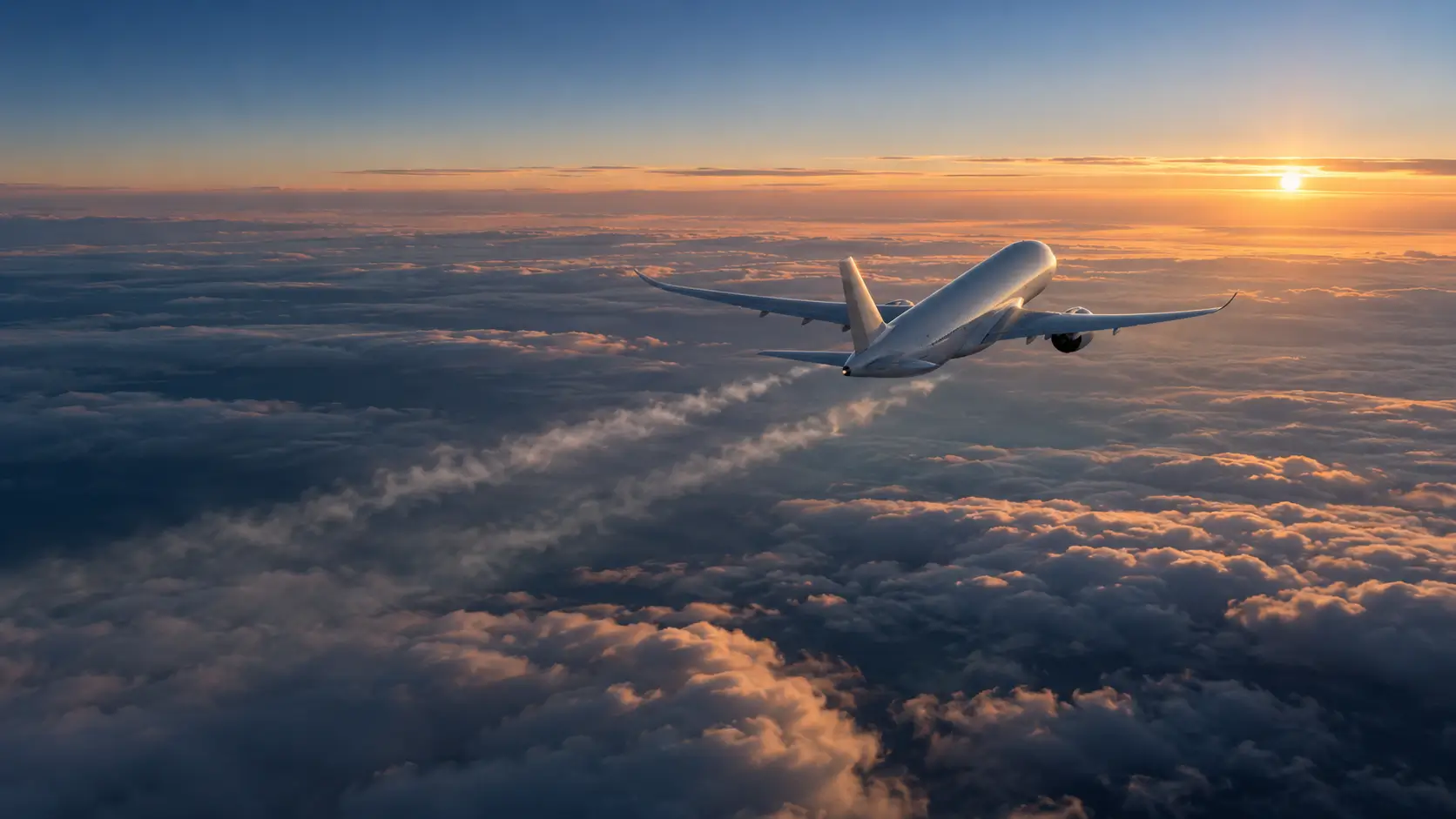
The white lines left by a plane seem to disappear quickly. However, some can persist for hours, spread into clouds and retain some of the heat that seeks to leave the atmosphere.
Cathay Pacific and Google announced on September 7, 2026 the expansion of tests using artificial intelligence to predict these condensation trails. The objective is not to eliminate aircraft emissions, but to avoid small atmospheric regions where a persistent trail may develop.
A first phase involving more than 80 flights would have reduced drag-related warming by about 40%. This result is encouraging, but it remains an estimate provided by the partners.
Why do some drags warm the climate?
A trail is formed when the hot and humid gases of a reactor meet with sufficiently cold air. Water vapour condenses around tiny particles, then freezes to create ice crystals.
Some sluts disappear almost immediately. Others persist, expand and become clouds comparable to thin cirrus.
These clouds can reflect part of the sunlight during the day, producing a cooling effect. However, they also retain the infrared heat emitted by the Earth. Night drags are of particular concern as they trap heat without reflecting on sunlight.
Google estimates, based in particular on the work of the Intergovernmental Panel on Climate Change, that drags account for about one third of the total climate impact of aviation. This proportion remains uncertain and varies according to the calculation methods. The Google research project explains these mechanisms and their main uncertainties.
How does the AI change a flight?
The system combines weather forecasts, flight data and satellite images. A model of artificial intelligence is looking for the cold and very humid air layers where a persistent drag may appear.
A different course or altitude may then be proposed before or during the flight. It may be enough to climb or descend a few hundred meters to leave the problematic layer.
IA does not take control of the aircraft alone. Air dispatchers, pilots and air controllers retain authority and must take into account traffic, turbulence, weather, fuel and safety rules.
According to Reuters, the Cathay trial began in late 2025. More than 80 flights were studied, including on very long-haul routes.
Cathay becomes Google's leading commercial airline partner in the Asia-Pacific region for this technology. The second phase must now cover more of its Asian and trans-Pacific network.
Encouraging but complex results
Cathay and Google estimate the reduction in drag warming effect in the first phase at 40%. However, companies have not yet published the exact number of modified flights, routes, altitude changes, fuel consumption or margin of error.
Previous work allows for a better measurement of potential and difficulties.
An experiment with American Airlines involved approximately 2,400 transatlantic flights. Of these, 112 actually followed a plan of avoidance. These flights produced 62% fewer drags than the control group, with no statistically significant difference in fuel consumption.
When all eligible flights were included — even those whose crews had not followed the proposed course — the reduction was, however, only 11.6%. This result, described in a preliminary study published on arXiv, shows that technical effectiveness is not enough: recommendations must also be accepted and integrated into operations.
Another [study published in Communications Engineering] (https://www.nature.com/articles/s44172-024-00329-7) found an average increase of about 2% in fuel on actually modified flights. A deviation can therefore reduce short-term warming while producing more CO2, which remains in the atmosphere for a long time.
A solution for use with current aircraft
Technology has an important advantage: it does not require replacing engines or waiting for a new generation of devices.
Forecasts can be integrated into planning tools already used by airlines. Larger projects are also beginning to coordinate several carriers and air traffic control services.
Operation Blue Skies, supported by the British government, must experiment with this approach for 30 months in Shanwick's airspace on the North Atlantic. Approximately 10,000 flights will cross this area during trial periods, but only a small proportion will be diverted.
The official project foresees two operational campaigns of about four months. The trajectories will be chosen with NATS, the Met Office, universities and the organization Contrails.org.
Prices and availability in Canada
Google and Cathay Pacific did not report any deployment costs or tariffs for this technology.
It is not a product sold directly to passengers. An individual cannot select a "passenger flight" when booking, and no Canadian airline has announced an equivalent commercial partnership.
Costs will vary depending on integration with planning systems, weather data, computer processing, training, air traffic control services, number of flights and region.
Flights between Canada and Europe could potentially cross the sectors studied on the North Atlantic, but their participation should not be presumed.
Limits or Considerations
Weather forecasts cannot determine exactly where a trail will form or how long it will last.
Satellites may miss some dragged under natural clouds or assign a line to the wrong aircraft. Measuring the exact climate effect of an intervention therefore remains difficult.
Altitude changes may also increase fuel consumption, conflict with traffic or expose the aircraft to less favourable conditions. Safety must always take precedence over the environmental objective.
Finally, the avoidance of drags does not remove CO2, nitrogen oxides or other aviation emissions. It complements cleaner fuels, efficient appliances and the reduction of avoidable displacement.
Conclusion
Google's IAA does not make a plane clean. Rather, it seeks to avoid the few atmospheric layers where its passage may produce disproportionate warming.
The results of Cathay Pacific suggest that this intervention is possible with current aircraft and systems. The next phase will have to demonstrate that it operates on a larger network, without excessive fuel consumption and without complicating safe traffic management.
If these conditions are met, a slight change in altitude could become one of the fastest climate measurements to deploy in aviation.