NVIDIA wants to deliver almost ready AI plants in containers
NVIDIA wants to deliver calculation centers for preassembled AI in containers. This is what DSX POD promises and what the 14 days do not include.
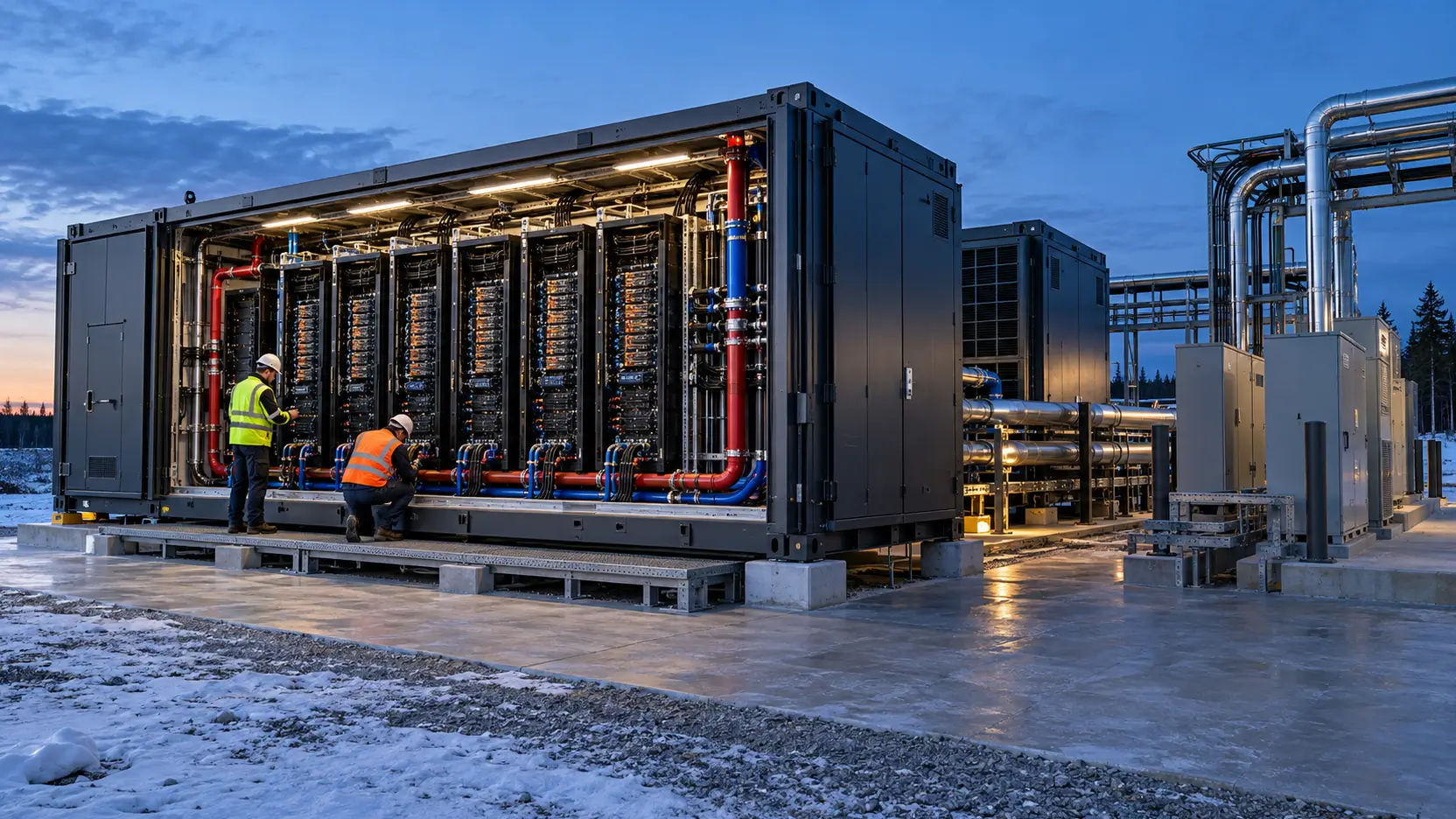
Building a computing centre for artificial intelligence is not simply about stacking graphics cards. It is necessary to connect hundreds of accelerators, distribute a huge amount of electricity, circulate coolant and test the whole before launching the first model.
With the DSX POD, announced on October 21, NVIDIA wants to move much of this work to a factory. The equipment would be assembled and validated inside containers and then transported to a prepared site. The company asserts that this method could reduce on-site commissioning from six months to as little as 14 days.
A calculation cluster mounted before delivery
The DSX POD is not a complete data centre sold directly by NVIDIA. It is a reference architecture that partners such as Dell, HPE, Lenovo, Schneider Electric and Vertiv can manufacture, adapt and install.
Each calculation container must gather seven Vera Rubin NVL72 systems, i.e. 504 Rubin graphics processors according to [Barron Wiring between bays, electrical distribution, liquid cooling lines, sensors and part of the network are installed and verified prior to shipment.
Instead of receiving dozens of separate components and integrating them on the site, the operator receives a unit already tested. Teams can prepare the ground while the supplier assembles the container, allowing for several steps in parallel.
Fourteen days, but only on a ready site
The most spectacular promise must be nuanced. NVIDIA talks about a deployment that can take as little as 14 days on a prepared site. Its own technical document specifies that the customer still has to provide the foundation, network connection, power supply, water, heat discharge system and telecommunications links.
The container is therefore not a supercomputer which is placed in a parking lot before connecting it. Its standard electrical input works at 800 V DC, while the regional upstream solution must be designed by the partners according to local standards and network capacity.
NVIDIA states that preassembly reduces errors, component delays, and specialized on-site work. However, the reduction from six months to 14 days has not yet been demonstrated by an independent commercial deployment. The first solutions are planned in early 2027.
Why these containers count
The demand for calculation increases faster than the capacity to build traditional centres. The modular model would add almost identical blocks as electricity and land become available. It could also facilitate temporary or remote facilities, provided the necessary infrastructure exists.
However, this acceleration does not solve the energy problem. According to the [International Energy Agency] (https://www.iea.org/reports/key-questions-on-energy-and-ai/executive-summary), global electricity consumption in data centres could almost double, from 485 TWh in 2025 to about 950 TWh in 2030. Building faster can therefore move the bottleneck to power grids, transformers and energy generation.
Prices, availability and Canada
NVIDIA did not communicate any prices. Each facility will be configured and sold by a partner according to the number of containers, storage, network, power supply, cooling, civil works and services required. The cost will therefore vary greatly depending on configuration, supplier, site and region.
The manufacturer announces global availability through partners in early 2027, but no specific dates, configurations or Canadian offerings are confirmed. It is currently an announced architecture, not a standard product available in stores or a facility already licensed for a Canadian site.
Limits and Considerations
Standardization can speed up integration, but it does not create electricity or network capacity. A project remains dependent on permits, connections, civil engineering, water supply or a climate-friendly cooling solution.
The transport of very heavy equipment already installed also imposes vibration, structural and test stresses after arrival. Finally, a highly integrated architecture around Vera Rubin can increase reliance on NVIDIA and its ecosystem as partners.
Conclusion
DSX POD transposes to the calculation center a logic already common in the construction: pre-manufacture in the factory what is long and risky to assemble on site. The approach could really speed up the addition of capacity for AI.
However, the promise must be read correctly. The 14 days start when the ground, electricity, cooling and grid are already ready. NVIDIA does not remove the construction of a data centre; it moves a complex part of this construction towards the factory.