
Helios reaches 99995% logical fidelity: what this quantum record really means
Helios reaches 99995% logical fidelity. A promising record for quantum computing, but still limited to a corrected quantum memory.
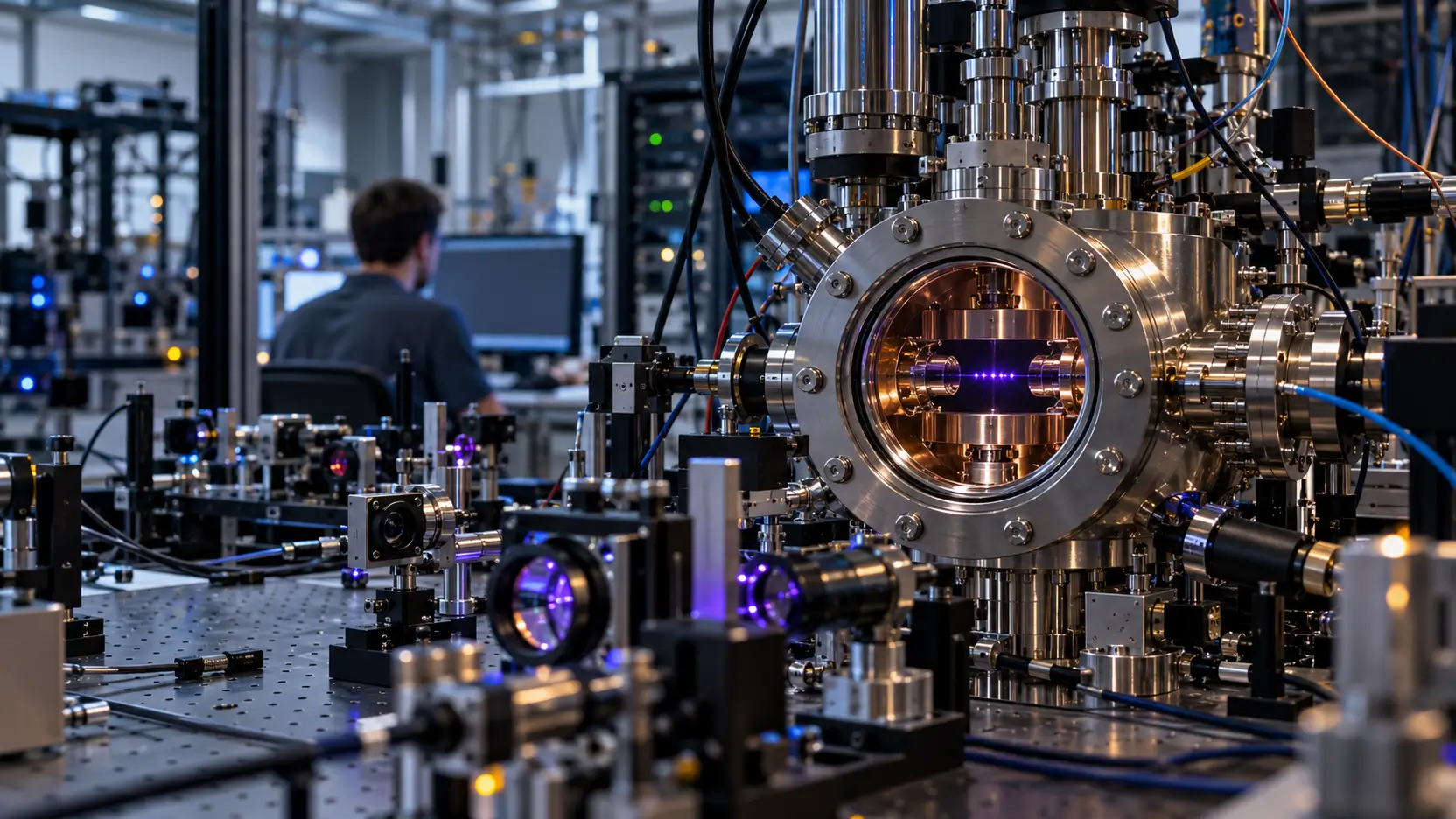
Quantinuum claims to have taken an important step towards quantum computers capable of correcting their own errors. On its Helios system, the company measured a logical error rate estimated at only five failures per million correction cycles, representing a fidelity of 99.9995 %.
The figure is remarkable, but its meaning needs to be clarified. It does not mean that Helios performed a million useful quantum operations without error. The experience mainly measures the ability of a logical memory to store information during repeated detection and correction cycles.
Why quantum computers make so many mistakes
A Qubit is extremely sensitive to noise, logical door imperfections and interactions with its environment. To protect information, researchers therefore divide it between several physical quots. The set forms a logical quabit: individual errors can be detected and corrected without directly reading the protected quantum state.
This redundancy only works if the material is already accurate enough. Adding qubits and operations also creates new opportunities to fail. The real threshold is crossed when increasing protection reduces errors faster than it adds.
The quantinuum technical manuscrit indicates that errors decreased by an average factor of 12 when researchers passed between distance color codes 3, 5 and 7. This exponential suppression is the most important result: it suggests that a more robust code actually improves memory rather than just multiply hardware.
Three failures observed, then an estimated rate
For distance code 7, each trial included 20 cycles of syndrome extraction, the process used to identify errors. The team performed 29,000 tests and observed three logical failures. Based on this data, it estimates the error rate at 5 × 10⁻⁶ per cycle, with an uncertainty of +4/−2 × 10−6.
In other words, "five errors per million" is a statistical estimate, not the count of a continuous sequence comprising exactly one million transactions. However, the result was obtained on the true Helios processor, not only in simulation.
The memory record uses 73 physical quibits to protect a single logical quibit. The same work also tests two-bit Clifford logical doors with distance codes 3 and 5. Their best error rate is 7 × 10⁻⁵ per Clifford logical door, with 37 physical quads per block. This distinction explains why excellent memory is not yet enough to build a fault-tolerant universal computer.
Why the result is still important
Quantinuum uses trapped barium ions as quibits. Helios has 98 physical quads and complete connectivity, which facilitates some correction codes that require long-range interactions. The researchers also tested classic and neuronal decoders capable of interpreting error signals quickly enough to consider real-time correction.
In its announcement of October 19, Quantinuum presents the result as ten times better than its September record and more than one hundred times better than the best result published on a superconducting architecture. This is a comparison made by the company. Robin Blume-Kohout, a Sandia laboratory researcher who did not participate in the study, nevertheless described the gain as serious in a statement taken by [HPCwire] (https://www.hpcwire.com/2026/10/19/quantinuum-says-helios-results-strongthen-its-path-to-apolli/).
Prices, Access and Availability in Canada
Helios is not a retail computer. Quantinuum states that its system is accessible through its cloud service or through an on-site installation, but does not publish any standard rates. The price is likely to depend on contract, calculation time and support; no reliable range is available.
The manufacturer does not confirm a portal, Canadian dollar price or Helios installation in Canada. An interested Canadian organization should contact Quantinuum directly. Therefore, immediate access or conditions identical to those of US customers should not be presumed.
Limits or Considerations
The manuscript provides much more details than a press release, but it comes entirely from Quantinuum researchers and was not yet accompanied by an independent validation reproducing the record. The three failures observed also produce a relatively wide margin of uncertainty.
The memory demonstration does not include all the operations necessary for a long universal algorithm. Error treatment was performed offline during the study, although several decoders showed latency consistent with real time. Finally, the Apollo target of 2029 and the assertion that architecture requires much less than its competitors to be projected by the manufacturer.
Conclusion
The result of Helios does not make the quantum computer tolerant to failures immediately available. However, it shows something very important: on this equipment, increasing the protection of a logical quadbit quickly reduces the error rate, up to about five failures estimated per million memory cycles.
The next decisive evidence will be to apply this precision to many logical qubits, all necessary doors and calculations long enough to produce a useful benefit. Quantinuum has just strengthened the credibility of this journey, without yet crossing the finish line.