
Maestro: Cadence specialized AI wants to speed up chip design
Cadence launches Maestro, specialized d的IA models to design and verify chips. This is their operation, their promises and their limits.
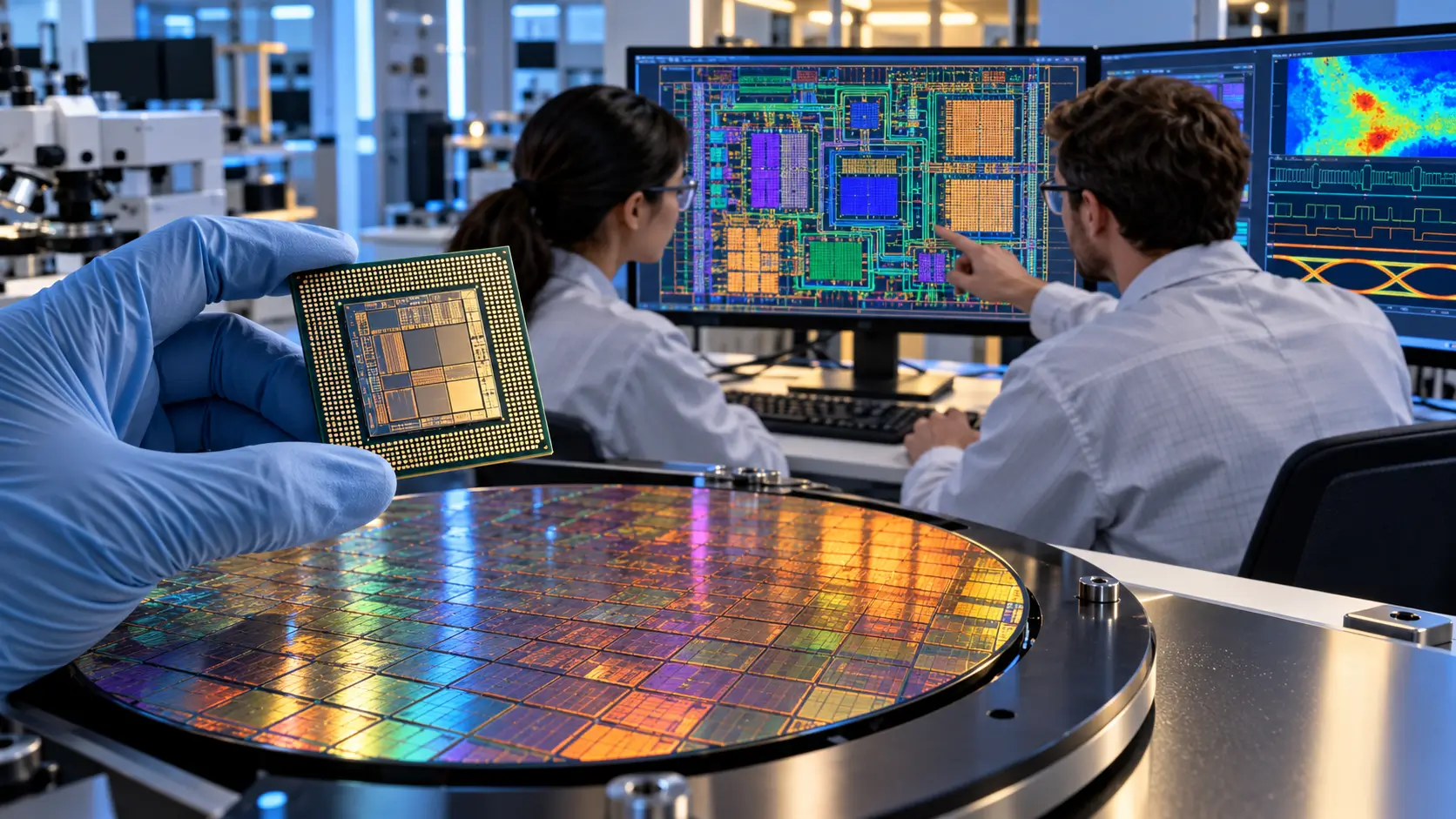
Designing a modern chip is not just drawing a circuit. It is necessary to place and link billions of transistors while respecting sometimes contradictory objectives of performance, consumption, area and cost. Cadence wants to entrust part of this work to Maestro, a portfolio of specialized artificial intelligence models announced on October 26, 2026.
The idea is not to ask a conversational robot to produce a finished chip. Rather, Maestro must feed Cadence's "super agents", who can interpret an objective, divide it into tasks and call for appropriate design and verification tools. The first models will be offered in advance to some customers in the fourth quarter of 2026, according to the [ Cadence release](https://www.cadence.com/zh TW/home/company/newsroom/press-releases/pr/2026/cadence-introduces-maestro-a-domain-specialized-ai-model.html).
An AI trained to speak the language of engineers
Maestro brings together leading language models adapted to the field, decision-making models and agent skills capable of improving. They must integrate into AuraStack, ChipStack, InnoStack and ViraStack platforms as well as Cadence's electronic design automation software.
An important difference with a generalist AI is the verification loop. Cadence explains that reinforcement learning can be based on the results of its deterministic solvers and engineering tools: the agent proposes an action, measures its effects on specific criteria, and then adjusts its approach. This method does not guarantee that a response is correct, but it anchors the work in technical measures rather than in simply plausible text.
Part of the technology is based on NVIDIA Nemotron models. Cadence also plans to use OpenShell, an open running environment designed to better isolate and frame agents. Reuters customers will be able to customize the models and run them in the Cadence cloud, in a public cloud or on their own infrastructure.
Why local execution counts
Schematics, manufacturing parameters and the choice of chip architecture are very sensitive intellectual property. The possibility of running Maestro in a company-controlled environment could therefore be of interest to manufacturers who are reluctant to transmit their data to a shared service.
The other potential advantage is time. An officer can explore multiple compromises, re-launch specialized tools and document results without waiting for each manual intervention. Cadence claims to achieve up to 30% improvement in the "quality" of results and up to five times more efficiency in the use of chips than with a generalistic model. These figures are from the manufacturer only and have not yet been validated independently.
Availability, prices and Canada
Maestro is not yet available to the general public or all companies. Initial access must begin in the fourth quarter of 2026 for a selection of clients; No date of general availability or availability specific to Canada has been announced.
According to [Tom However, the manufacturer did not provide any reliable price ranges. The actual cost may vary depending on licences, volume of use, infrastructure, trade agreement and region.
Limits and Considerations
Maestro remains an early access product. Cadence did not specify exactly what its 30% "quality" gain is, and the generalist model used for comparison was not named. This will require testing of actual projects and independent evaluations.
An officer may also choose a wrong tool, misinterpret a constraint, or produce a track that fails the audit. Engineers will remain responsible for deterministic controls, safety, confidentiality and final approval prior to manufacture. Using an isolated environment like OpenShell reduces some operational risks, but does not eliminate them.
Conclusion
Maestro illustrates a more credible evolution than the promise of an AI capable of doing everything: specialized models, linked to engineering software and corrected by measurable results. If Cadence demonstrates its gains with real clients, this approach could shorten certain design steps. At the moment, however, the figures announced must be regarded as manufacturer's objectives, not as acquired performance.